
AI news ·
Google DeepMind VP Raia Hadsell outlines research agenda spanning weather forecasting, 3D simulation and multimodal AI
Google DeepMind VP Raia Hadsell leads over 1,200 researchers across robotics, weather forecasting, and 3D world generation. New releases include GenCast, which beats physics-based forecasts 97% of the time, and Gemini Embeddings 2.
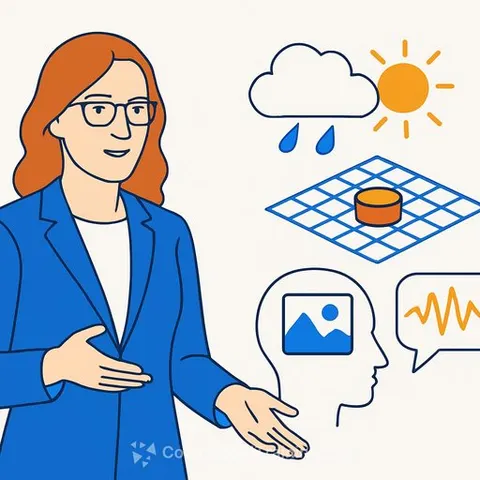
DeepMind VP Maps Out AI Research Beyond Large Language Models
Raia Hadsell, VP of Research at Google DeepMind, outlined the company's multi-domain AI Research agenda at AI Engineer Europe, emphasizing work in robotics, weather forecasting, and 3D world generation alongside foundational model development.
Hadsell leads a team of over 1,200 scientists and engineers across 10 labs. Her background in philosophy shaped her approach to fundamental questions about intelligence before she moved into computational work on neural networks and robotics.
Gemini Embeddings 2: Unified Multimodal Representation
Google DeepMind released Gemini Embeddings 2, a model that maps text, images, video, audio, and PDFs into a single embedding space. The system processes these modalities directly rather than converting them through intermediate steps like optical character recognition or transcription.
The model tops benchmarks across modalities and supports over 100 languages. It launched in preview on Vertex AI and the Gemini API.
Weather Forecasting and Simulation
DeepMind introduced GenCast, a probabilistic weather forecasting model that generates multiple possible outcomes with uncertainty estimates. Weather's chaotic nature requires probabilistic forecasts rather than single predictions.
GenCast outperforms traditional physics-based forecasting methods on 97% of evaluations while running faster and with lower computational cost.
Interactive 3D World Generation
The lab developed Genie 2 and Genie 3, models that generate interactive 3D environments from text prompts. Genie 3 extends previous work with long-horizon memory for consistent generation over multiple minutes and allows users to insert events that shape the environment.
Hadsell demonstrated examples including playable worlds, futuristic cities, and detailed environments with interactive creatures.
Broader Research Areas
DeepMind's research spans five main areas: Agentic Worlds (embodied agents and world models), AI for Humans (social science, healthcare, education), Sustainability (climate and energy modeling), Creative Technologies, and Generative AI and LLM work on foundational learning.
The research program builds on earlier successes in game-based AI, including AlphaGo's victory in Go (2016), grandmaster-level performance in StarCraft II (2019), and robotics control tasks.