
AI news ·
Google names Booking.com and Expedia as agentic booking partners, adding a layer above OTAs rather than removing them
Google's agentic hotel booking partners include Booking.com and Expedia - the same OTAs the industry expected AI to bypass. The stack gained a new layer; nobody got cut out.
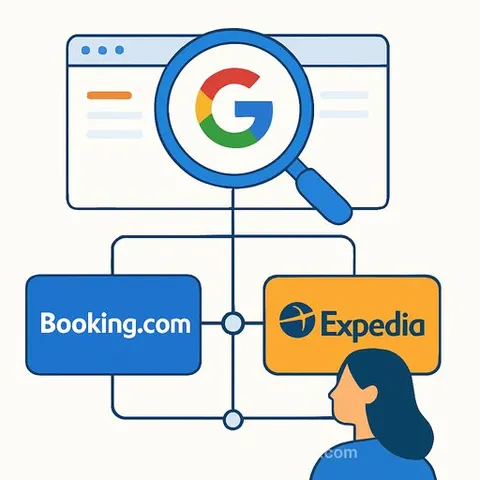
Google's Agentic Booking Partners Include the OTAs It Was Supposed to Bypass
Google announced its agentic commerce partners for hotel booking in November. The list includes Booking.com, Expedia, Marriott, IHG, Choice, and Wyndham. Two of those companies are the world's largest online travel agencies.
The hospitality industry spent the weeks after Google I/O telling a disintermediation story: AI agents would route travelers directly to hotel websites, finally cutting out the intermediaries that have taxed distribution for two decades. But the partner list tells a different story.
A disintermediation play does not launch with the parties it intends to disintermediate as founding partners. If Google were paving a road around the OTAs, Booking and Expedia would not be laying the asphalt.
What actually got added
Google introduced a commerce surface that lives across Search, Gemini, YouTube, and Gmail - a single place where travelers can ask an agent and complete a booking without leaving Google's ecosystem. The merchant of record stays with the hotel. The relationship with the traveler moves to Google.
That relationship is the asset. Not the transaction. The transaction can stay with the merchant; the protocol is built to leave the brand as merchant of record. What moves is the surface where the traveler arrives at the decision, and the record of everything they considered along the way.
Booking Holdings' CEO Glenn Fogel confirmed in April that the company is "incredibly excited about the position." He said Booking is working with Google, OpenAI, Anthropic, and Amazon at the same time. The company frames AI as a way to expand the market rather than a threat to it.
But Booking is also building its own agents - Penny on Priceline, an expanding booking agent on Booking.com, and Lola, a separate venture it spun up this spring with Kayak's co-founders. The strategy is clear: when travelers delegate to an agent, Booking wants that delegation to happen inside Booking's environment, not someone else's.
Read that move closely. Booking's defense against the relationship migrating into an agent is to build the agent. This concedes the only point that matters: the booking is moving into an agent. The contested question is not whether. It is whose.
A new layer, not a shortcut
Google is building the cross-merchant agent that sits above everyone. Booking is building the in-house agent that keeps its own travelers in. Both are re-intermediation. Both add a layer that did not exist before.
The industry has spent a decade bracing for the wrong event. The recurring fear was that Google would become an OTA - holding inventory, contracting hotels, selling rooms in direct competition with Booking and Expedia. It never did.
What Google is doing is more durable than becoming an OTA, precisely because it carries none of the operational weight. Google is becoming the layer the OTAs book through. The surface above the surface.
That surface gets monetized the way every Google surface eventually does. Hotel search arrived free and grew a paid tier. Metasearch placement did the same. The auction has always followed the surface, and an agentic cart is a new surface. The named partners, who already buy their visibility from Google today, have no reason to expect the auction to skip it.
Where everyone lands
The OTAs move from occupying the demand surface to supplying one. They remain indispensable for inventory, payments, and post-booking work an agent cannot do. But they stand a step further from the traveler than before.
The hotel chains on the partner list are betting their brands are strong enough to be the name an agent reaches for. Independent hotels inherit whatever terms get set above them, as they always have.
Whether the established players can extract favorable terms on the way in - use their inventory leverage to stay more than a supplier - is the open question. Booking's two-front strategy is an attempt to answer it. Whether it works is not something this announcement decides.
What the announcement decides is the direction: a layer is forming, and the inventory is moving in under it willingly. Nobody gets cut out. The OTAs are on the list. The chains are on the list. The agents will route through them, not around them.
The right question is quieter. When the surface belongs to Google and the inventory belongs to everyone else, who owns the relationship with the traveler? The stack just grew a new top floor. The booking still happens. It just happens one level up from where it used to - and the party standing on the new floor is the one that was there all along.
Related: AI Agents & Automation | AI for Hospitality & Events