
AI news ·
Grocers find operational artificial intelligence more valuable than consumer-facing tools
Albertsons uses AI to check strawberry quality and cut waste. These tools offer better returns than consumer apps without needing a 2,000-person tech team.
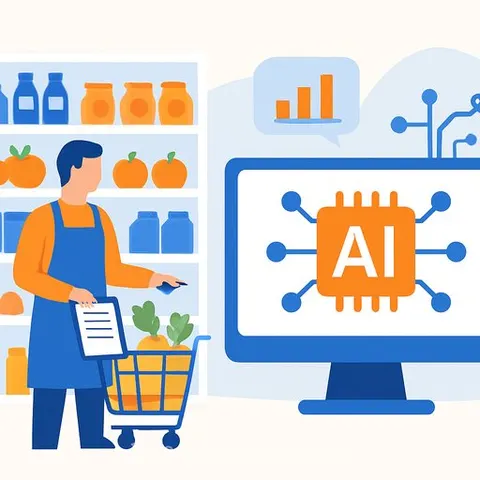
Albertsons launched a proprietary AI tool that lets warehouse workers instantly check whether pallets of fresh strawberries meet company quality standards. The move, which followed a flashier consumer-facing shopping assistant by five months, highlights where the grocery industry is finding the most immediate value from AI: in back-end operations that directly impact shrink, labor costs, and margins.
Operational AI is tackling decades-old problems
While AI-powered chatbots and personalized recommendations grab headlines, tools focused on the backroom, warehouse, and corporate office are solving persistent challenges. These include reducing food waste, managing complex promotions, setting dynamic prices, and improving worker engagement. Hy-Vee partnered with Relex to sharpen fresh product forecasting. Heritage Grocers Group uses an AI system to scale pricing promotions. Grocery Outlet is incorporating Afresh for better ordering. Kroger's Sage virtual assistant helps employees manage schedules and tasks.
Curt Prins, a senior product manager at Albertsons and former Kroger employee, said back-end AI solutions can deliver a much stronger return on investment than consumer-facing tools. "They don't need a 2,000-head technology team to do this," Prins said. "They can make smart partnerships and focus on impact as opposed to the bright and shiny things."
That focus on AI for Operations is not limited to industry giants. Regional and independent grocers can use these solutions to cut waste and boost accuracy, giving them a better shot at competing with larger rivals. The first step, Prins said, is identifying operational pain points.
Bad data undercuts even the best AI
The catch is that AI tools are only as good as the data they feed on. Disjointed, incomplete data will produce unreliable signals. Tom Furphy, CEO of Consumer Equity Partners and a former Amazon and Wegmans executive, said cleaning up internal data is a priority. But retailers don't need to wait for perfection. "You don't necessarily have to wait completely until your data is fixed or is ready, but don't go too far with AI on top of that data because it's going to give you bad signals," he said.
Prins pointed out that bad data management can sabotage even well-intentioned consumer-facing efforts. A personalized promotion for a product that's out of stock becomes a customer loyalty problem. "AI is a capability, not a strategy," he said.
The long road to agentic retailing
Beyond one-off tools lies a future where grocery operations are not just automated, but agentic. Walmart already uses agentic AI to get a unified view of inventory across stores and supply facilities. Experts predict that roles like category manager will change dramatically. Bobby Gibbs, principal at Oliver Wyman, said agentic technology could draw data from across the enterprise to run multiple vendor negotiation scenarios instead of one.
Gary Hawkins, founder and CEO of the Center for Advancing Retail & Technology, said advanced AI will eventually automate assortment planning and price optimization within parameters set by managers. "What's happening is that retail is moving from human speed to machine speed," he said. Achieving that requires a "data fabric" that runs like a spine across the business, allowing AI to make informed decisions that span departments.
Capri Brixey, a partner at The Partnering Group, said preparing for an agentic future is less about picking the right technology and more about navigating change management. Companies that see the best outcomes "are investing as much in enablement and process redesign as they are in technology," she said. Many are moving toward a matrixed organizational structure to speed decision-making as AI takes on more tasks.
Why this matters for operations professionals
The grocery industry's AI push is not about replacing workers with software. It's about equipping operations teams to make faster, more accurate decisions. The tools that matter most right now are those that tackle waste, inventory, and pricing - the very areas where operations managers feel daily pressure. The message from experts is clear: the biggest barrier isn't the technology itself, but the readiness of data and organizational culture. For operations leaders, that means building a data cleanup roadmap, breaking down silos, and getting hands-on with AI tools that can deliver measurable impact today. Following an AI Learning Path for Operations Managers can help build the skills needed to evaluate and deploy these systems effectively.