
AI news ·
Gulf organizations prioritize AI governance and operational resilience over rapid deployment
Gulf organizations are shifting from AI pilots to enterprise deployment. PwC finds 74% of AI value is captured by just 20% of organizations that prioritize governance.
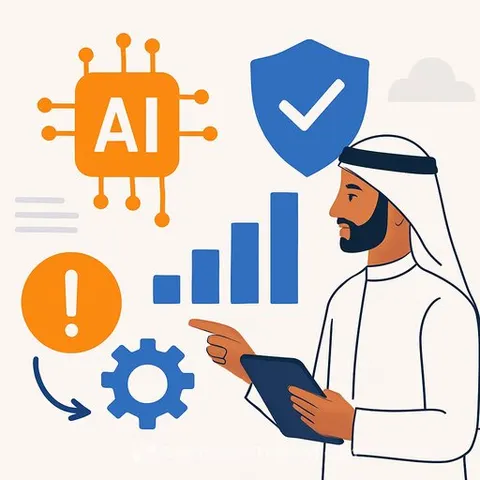
During the first quarter of 2026, organizations across the Gulf region shifted their focus from AI experimentation to enterprise-wide deployment. Geopolitical tensions, supply chain disruptions, and energy market uncertainties forced executives to prioritize institutional readiness over quick pilot launches. The defining challenge is no longer whether to invest in AI, but whether companies possess the governance, infrastructure, and operational models required to scale it successfully.
Early AI adoption focused on launching proof-of-concept projects. Organizations now realize that moving beyond these pilots requires a fundamentally different set of capabilities. Access to models and capital remains strong, but many firms struggle to integrate these tools into daily operations.
Hesham Fayed, President of Middle East and Africa at DXC Technology, noted this change in client priorities, observing that the conversation has fundamentally shifted. "Clients aren't debating whether to pursue AI anymore," Fayed said. "They're asking why their current environment can't support it yet, and what it will take to get there. That's the defining pattern of this quarter."
A PwC study indicates that 74% of AI's economic value is captured by just 20% of organizations. This disparity stems from clear governance structures, integrated data environments, and executive alignment, rather than superior technology budgets. Furthermore, Deloitte reports that more than 80% of organizations globally have yet to redesign jobs and workflows to use AI meaningfully.
Public and private sector lessons
The first quarter highlighted the contrasting approaches of public and private sector organizations. Public institutions in Saudi Arabia and the UAE prioritized governance, accountability, and sovereignty from the start. Private companies often chased speed to establish a competitive advantage before governance frameworks matured.
This quick private-sector movement is now creating technical and governance debt. "What we're seeing now is a reset," Fayed said. "Organizations are having to retrofit governance, security, and controls after the fact, and that's proving more complex and more costly than getting it right up front."
Zane Ul Haq, Head of MENA at Endava, observed that heavily regulated industries like financial services are moving more cautiously. This slower pace reflects a high degree of maturity as they solve foundational challenges around trust, compliance, and operational risk.
Resilience as a strategic enabler
Governance and resilience have merged into top investment priorities for regional executives. Organizations no longer view cybersecurity, automation, and sovereign infrastructure as purely defensive functions-they treat these capabilities as strategic enablers of growth and operational continuity.
The threat environment continues to grow. TrendAI's State of AI Security Report noted that more than 2,130 AI-related vulnerabilities were disclosed globally during 2025, a 34.6% year-over-year increase. Salah Suleiman, Managing Director of South Gulf at TrendAI, said cybersecurity is now a boardroom-level imperative with direct implications for operational resilience and regulatory compliance.
Loubna Imenchal, Managing Director for the Middle East, Africa, Turkey, and Central Asia at Axis Communications, highlighted a shift toward predictive, intelligence-led operations. Governments and enterprises are viewing security as a strategic enabler of urban efficiency, public safety, and citizen experience.
Why this matters for executives and strategy
Leaders must move beyond measuring success by the number of AI pilots launched. The upcoming competitive divide will separate organizations that merely adopt technology from those that redesign workflows and establish rigorous governance.
C-suite leaders and boards must treat AI governance, digital sovereignty, and operational resilience as interconnected strategic risks. Embedding AI into day-to-day decision-making requires redesigning team structures around these new capabilities. For those looking to build these capabilities, exploring an AI Learning Path for CEOs can provide structured guidance on establishing the necessary operating models and leadership alignment.