
AI news ·
Hawaii bill requiring AI platforms to protect minors from harm awaits governor's signature
Hawaii's Senate Bill 3001 requires AI companion platforms to add safeguards against harmful content for minors or face penalties under state consumer protection laws. The bill, now awaiting the governor's decision by July, mandates annual reports and response protocols for self-harm prompts.
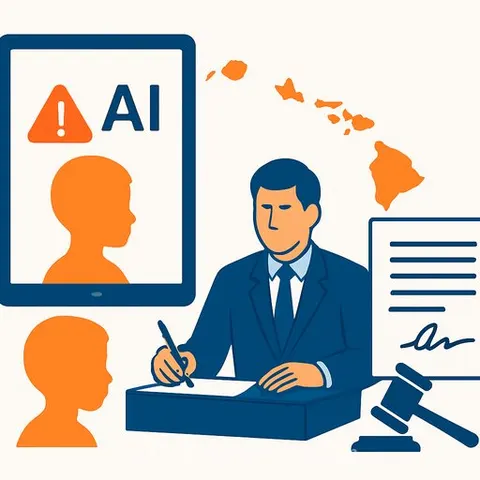
A bill requiring AI companion platforms to protect minors from harmful interactions now awaits Gov. Josh Green's signature or veto, with a July deadline. Senate Bill 3001 mandates that operators provide user disclosures, establish response protocols for prompts involving suicidal ideation or self-harm, and implement safeguards - or face penalties under Hawaii's consumer protection laws.
The legislation passed in May and would require operators to submit annual reports to the Hawaii Department of Health's Behavioral Health Administration. Violations would be treated as unfair or deceptive acts or practices under state law.
What the bill requires from AI platforms
The measure targets AI chatbots designed to simulate companionship and emotional relationships - services that have drawn scrutiny as more minors use them. Kris Coffield, executive director of Imua Alliance, pointed to the absence of industry standards. "We've seen artificial intelligence have a significant impact on youth mental health through AI chats and AI services, and there aren't robust protocols for technology companies regarding how they operate these platforms," Coffield said. "SB 3001 establishes clear protocols for companies in this space."
State Sen. Jarrett Keohokalole cited specific examples of misuse. He previously shared transcripts showing a chatbot using inappropriate language with a 12-year-old Hawaii girl who was role-playing as an anime superhero. Lawmakers designed the bill to address risks including exposure to sexualized content, self-harm encouragement, grooming behavior, and situations where minors rely on AI systems for emotional support or mental health guidance.
Legal groundwork and enforcement
The bill's language was crafted in coordination with the Hawaii Attorney General's Office to reduce the likelihood of legal challenges from AI operators. "We worked with the Attorney General's Office on language to make sure the bill was sufficiently clear and reduce the likelihood of legal challenges from AI operators," Keohokalole said.
If signed, the law would give the state a direct enforcement mechanism by classifying violations as deceptive trade practices. The annual reporting requirement to the Behavioral Health Administration creates an ongoing oversight structure rather than a one-time compliance check.
Why this matters for government and IT professionals
Hawaii's bill represents one of the first state-level attempts to regulate AI companion platforms through consumer protection law rather than standalone tech legislation. For government and IT professionals, the enforcement model matters: it piggybacks on existing unfair trade practices statutes, which could become a template other states adopt. Developers and platform operators should watch whether the required "protocols" get defined through agency rulemaking or remain broad - that distinction will determine compliance costs and technical implementation requirements for any AI service that minors might access.