
AI news ·
Headless AI connects siloed healthcare systems to automate complex workflows
Luma Health's president urges using headless AI to connect siloed health systems and automate prior authorizations. This replaces manual data entry, freeing staff for patient care.
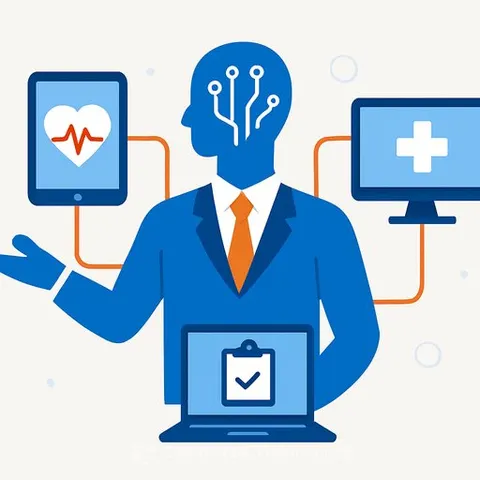
Healthcare organizations should turn their attention to building a coordination layer that connects siloed systems and automates complex workflows, according to Aditya Bansod, co-founder and president of Luma Health. Bansod calls the approach "headless AI," and he argues it could reshape healthcare operations as profoundly as the widespread adoption of electronic health records.
Despite the growth of AI for Healthcare, much of the industry's day-to-day work still depends on people manually moving information between electronic health records, payer portals, scheduling platforms and other systems. That integration work, Bansod said, is the real problem healthcare organizations should be solving next.
Moving beyond application-by-application AI
Referrals and prior authorization illustrate how employees continue to serve as the human glue between disconnected technologies. Even health systems with mature EHR environments require staff to search across payer portals, fax queues, documentation repositories and workflow tools to complete a single prior authorization. Referral management presents similar challenges - staff interpret incoming faxes, locate or create patient records, verify insurance and contact patients to schedule appointments, with each step happening in a different application.
"When you strip away the UI and go headless in an AI environment, you can simply ask, 'What is the prior auth for patient John Doe?' and have it reach out, connect, synthesize, and reason over all those different platforms," Bansod said. The resulting information would then be pushed back into the appropriate clinical or scheduling workflow, letting staff spend less time gathering data and more time acting on it.
Building on existing investments
Healthcare organizations have already devoted substantial resources to robotic process automation, workflow engines and AI assistants. Bansod said headless AI should not be seen as a replacement for those investments. Instead, it is a way of connecting them.
"The most interesting part is that headless isn't necessarily a technology," he said. "Headless is really the ability to take other technologies you've invested in and gotten working, then stitch them together in an interesting way and solve problems that were not solvable before." That could enable organizations to ask broader operational questions that span multiple systems - identifying clinicians who may be under-coding certain services or finding patients who canceled preventive visits but have not returned for care in months. Once identified, organizations could proactively reach out to patients or consider alternative care delivery models.
Governance remains essential
As AI Agents & Automation begin executing work across multiple enterprise systems, governance and auditability become critical. Bansod believes health systems can build those safeguards by extending many of the same controls already used for human users. Within individual applications, AI agents should operate with their own identities, permissions and role-based access controls rather than relying on shared accounts. That allows every action to be traced back to a specific agent.
Organizations also need visibility into how AI operates across systems. The coordination platform should maintain comprehensive records showing the tools an AI agent accessed, the external systems it connected to and the commands it executed throughout a workflow. Having both application-level and platform-level audit trails enables compliance teams to reconstruct exactly what an AI agent did and why.
Refocusing healthcare on patient care
Looking several years ahead, Bansod believes the broader opportunity extends beyond operational efficiency. He argues healthcare has gradually accepted large administrative infrastructures as a normal cost of delivering care, even though those functions do not directly benefit patients.
"This might be a spicy take, but I don't believe that people have to be the coordination layer across healthcare operations," he said. "The purpose of healthcare is not having people coordinate healthcare. The purpose of healthcare is providing care to patients." He envisions AI absorbing much of the administrative coordination that now consumes healthcare workers' time, allowing physicians and staff to focus more directly on patient care. "That coordination work is exactly what AI should absorb," Bansod said, "so the people in healthcare can get back to the part that matters, which is treating patients."
Why this matters for healthcare
For health system leaders, the headless AI concept shifts the conversation from deploying yet another AI tool to building an intelligent coordination fabric across existing systems. The immediate steps include evaluating where manual information-switching creates the most friction - referrals and prior authorization are prime candidates - and designing governance frameworks for autonomous agents that include identity, permissions and audit trails. The goal is not to replace staff but to remove the integration work that keeps them from patient care. Organizations that begin stitching together their automation investments now will be positioned to redirect clinical and administrative talent toward the work that actually improves outcomes.