
AI news ·
Healthcare automation's first wave fails on reliability, not vision, industry veteran says
Early healthcare automation collapsed under the weight of changing payer portals and inconsistent workflows. Newer AI systems can handle that variability - but only if organizations fix how they implement, not just what they deploy.
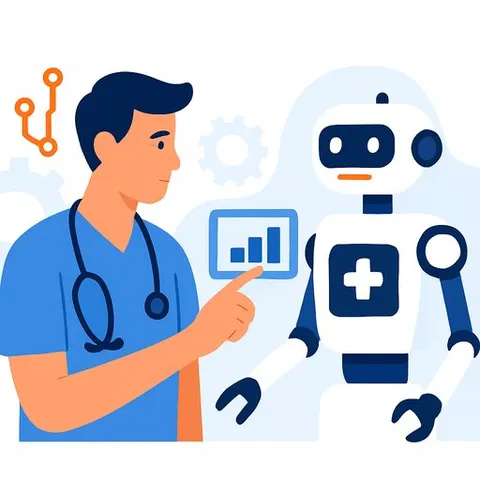
Healthcare Automation's Second Act: Why This Time Is Different
Healthcare organizations spent the last decade chasing automation that didn't stick. Prior authorizations, eligibility checks and claims processing remained bottlenecks. Staff restructured around systems that broke when vendors updated a portal. The technology simply wasn't ready for healthcare's operational reality.
The first generation of automation relied on rigid rules and deterministic workflows. Robotic process automation, or RPA, worked in narrow, controlled environments. But healthcare isn't narrow or controlled. Payer portals change constantly. Workflows vary across organizations. Documentation is inconsistent. When automation assumed a static environment, it failed the moment anything shifted.
Why the first wave failed
Every deployment became custom work. Every workflow variation required new logic. Every payer portal behaved differently. As complexity increased, reliability decreased.
When systems failed, the consequences rippled through operations. Claims didn't get submitted. Authorizations stalled. Staff had to return to workflows they thought had already been automated. Organizations had already restructured around those systems - teams reassigned, labor models shifted. Suddenly they were rebuilding workforce capacity while operating under staffing shortages and financial pressure.
The deeper damage was loss of trust. Healthcare leaders learned that automation only works when it's repeatable across organizations, workflows, payer rules and legacy systems that change constantly. The industry didn't underestimate the value of automation. It underestimated the complexity of deploying and supporting it.
What changed
The underlying technology has fundamentally shifted. Modern agentic AI systems are adaptive in ways earlier generations weren't. They can interpret context, navigate variability and escalate uncertainty instead of blindly executing through it.
This matters because healthcare workflows are fragmented, documentation is inconsistent and exceptions are constant. Historically, those realities broke automation. Agentic systems are equipped to operate inside that variability - not because they're perfect, but because they're built to handle it.
How to implement differently this time
Better technology alone won't guarantee better outcomes. Healthcare organizations need to change their approach.
- Start with operational strategy, not technology. The question shouldn't be "Where can we apply AI?" Ask instead: "Where are our biggest operational constraints, and what workflows are mature enough to automate reliably?"
- Focus before scaling. Organizations seeing success today aren't automating everything at once. They operationalize a small number of high-impact workflows reliably before expanding.
- Prioritize production over pilots. Healthcare has no shortage of pilots. What matters is whether a system handles real-world variability, operational volume and edge cases consistently over time.
- Demand visibility and commitment. Force vendors to tackle a hard problem with a firm commitment to outcomes. Expect transparency into how automation operates, where escalation occurs and how decisions are made. Trust is built through operational visibility, not black-box systems.
The real opportunity
Healthcare was never wrong about needing automation. The administrative burden remains unsustainable. Workforce shortages continue to intensify. Operational complexity keeps increasing.
The first wave taught the industry that automation only works when reliability scales with ambition. For the first time, the technology is finally catching up to the vision. The question now is whether healthcare organizations have learned enough to implement differently.
Learn more about AI Agents & Automation and AI for Healthcare to understand how these systems are being deployed in practice.