
AI news ·
Healthcare IT leaders cite cultural resistance, not technology, as the main barrier to scaling AI initiatives
Cultural resistance, workflow misalignment, and fragmented data-not technical gaps-are the top barriers to AI adoption in hospitals. Clinicians adopt tools that fit existing workflows and keep them in control; those that don't get abandoned.
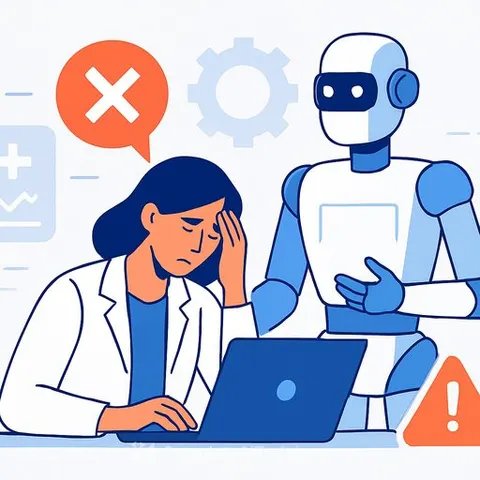
Healthcare Leaders Share Real Barriers to AI Scaling-and What Actually Works
Hospitals and health systems across the country are discovering that deploying AI at scale requires far more than selecting the right algorithm. According to healthcare executives and IT leaders, the biggest obstacles are cultural resistance, workflow misalignment, and data fragmentation-not technical capability.
The consensus is clear: clinicians have been burned before. Previous technology implementations promised efficiency but delivered additional documentation burdens and workflow disruption. Trust, therefore, becomes the currency that determines whether an AI initiative succeeds or stalls.
Data and Integration Remain Foundational Barriers
Poor data quality and fragmented systems undermine AI performance across healthcare organizations. Legacy infrastructure, siloed records, and limited interoperability between clinical systems prevent reliable AI deployment.
Organizations addressing this barrier invest in standardized data frameworks and deeper integration with existing systems like electronic health records. The goal is to remove the manual work of stitching data together so teams can focus on measurable outcomes.
Workflow Integration Determines Real-World Adoption
AI tools deployed outside existing workflows get ignored or abandoned. Healthcare leaders emphasized that effective scaling requires embedding AI directly into the systems clinicians already use-not asking them to adopt new platforms.
This means integrating AI into clinical decision points where it matters: ambient documentation, risk prioritization, and decision support. When AI reduces repetitive manual tasks without adding noise to a clinician's day, adoption follows naturally.
Starting with low-risk workflows that show quick, measurable impact builds momentum for larger initiatives. Early wins demonstrate tangible value-fewer documentation hours, reduced errors, faster treatment pathways-which justify broader investment.
Trust Requires Transparency and Clinician Control
About 30 to 35 percent of clinical AI initiatives focus on direct clinical care rather than autonomous decisions. This reflects a fundamental principle: clinicians adopt tools that augment their expertise, not replace their judgment.
Organizations scaling AI successfully involve frontline clinicians from the start, not after a solution is built. Co-design with clinical and operational staff ensures the tool solves real daily problems and fits local workflows.
Transparency about how AI generates recommendations and where accountability sits prevents adoption from stalling. When clinicians understand the system's logic and retain final decision-making authority, skepticism decreases.
Financial Strategy Shifts From Experimentation to Transformation
Organizations struggle when AI is framed as experimentation rather than a strategic investment tied to organizational priorities. Successful implementations connect AI directly to outcomes the organization is already accountable for-productivity gains, revenue cycle performance, reduced clinician burnout, improved patient experience.
Quantifying long-term value across operational efficiency, compliance, and workforce sustainability helps justify upfront costs. Demonstrating ROI through targeted use cases builds the case for scaling.
Governance Must Keep Pace With Rapid Adoption
Healthcare organizations face a new challenge: clinicians already use AI tools in their personal lives, creating "shadow AI" that operates outside organizational oversight. This makes flexible governance structures essential.
Following established standards like the National Institute of Standards and Technology AI Risk Management Framework provides a methodical approach to evaluating AI tools from initial assessment through ongoing maintenance. Proactive staff education on what is and isn't permitted allows organizations to capture efficiency gains while managing risk.
Small and Rural Hospitals Face Distinct Constraints
Large health systems struggle with data governance and cross-department coordination. Smaller and rural hospitals lack the budget, time, and internal expertise to safely evaluate AI, creating real fear about losing the human element of care.
What helps is reframing AI as burden reduction for clinicians already stretched thin. Clear use cases that solve specific daily problems, early involvement of frontline staff, and basic guardrails in place now-rather than waiting for formal regulation-build confidence and reduce resistance.
One pattern emerged across all perspectives: generic AI solutions rarely succeed without local adaptation. What works in an academic medical center fails in a rural hospital because patient populations and workflows differ fundamentally. Success requires embedded leadership that understands both the technology and the specific realities of local care delivery.
Learn more about AI for Healthcare and how to implement these strategies effectively.