
AI news ·
Hideo Kojima says generative AI will not create real art in his lifetime
Hideo Kojima says generative AI will not create true art in his lifetime. He views it as a tool for routine chores, keeping human design central to 2030's Physint.
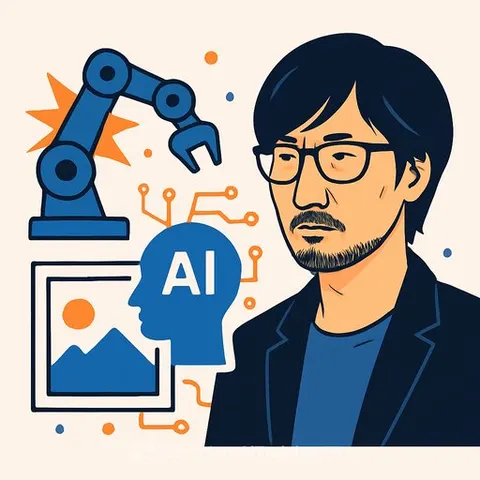
Game designer Hideo Kojima told the Washington Post that generative AI will not create true art within his lifetime, positioning the technology strictly as a tool for routine tasks. This clarification follows recent backlash over an AI-generated Prada promotional campaign, signaling to game developers and digital artists that human oversight remains non-negotiable in high-profile creative workflows.
The backlash and the pivot
Kojima addressed these views during a session at a Prada art event at New York's Chelsea Hotel. Weeks prior, he appeared in a promotional short film featuring a digital version of himself and director Nicolas Winding Refn on a space adventure. Gamers and critics widely condemned the project as low-quality artificial output.
A janitor for creative chores
Following the campaign, Kojima defined the boundaries of machine involvement in artistic production. "Art is life, but in 50 years, 100 years, I don't know. Maybe AI could create art, but while I live, I don't think I'll see it. I'm not interested in it," he said. The Washington Post reported that Kojima views the technology as a "janitor for creative chores," insisting that humans must remain the ones making decisions when producing Generative Art. He added that finding a better path for this technology falls to the younger generation.
Focus on control systems, not visuals
Kojima has previously shown more enthusiasm for machine learning, but his focus remains on backend systems rather than visual generation. "Rather than having AI create visuals or anything like that, I'm more interested in using AI in the control systems," he said. This distinction highlights practical AI for Creatives as a backend tool rather than a replacement for artistic vision.
Implications for upcoming titles
Given this measured perspective, Kojima is unlikely to integrate machine-generated artwork into his upcoming releases. His next projects include the Xbox-exclusive horror game OD and the PlayStation-exclusive Physint, the latter of which is not expected until 2030. These titles will rely on traditional development pipelines, keeping the human element at the center of the design process.
Why this matters for creatives
Industry leaders are actively drawing hard lines between administrative automation and actual artistic creation. For designers and developers, this reinforces that machine learning tools are best deployed to handle repetitive backend tasks, leaving conceptual and visual direction entirely in human hands.