
AI news ·
High school teacher uses AI to personalize instruction and argues schools must teach ethical use
The 2026 Smithsonian summit features 2 AI sessions on ethical student use. Teachers will learn to replace copy-paste cheating with Socratic dialogue.
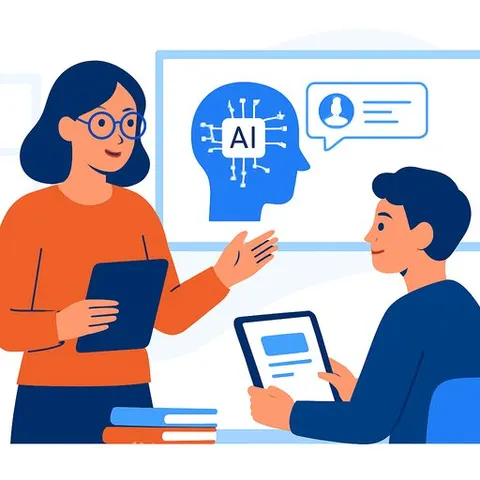
A 15-year-old student named Jake stood at his teacher's desk after class and voiced a concern that cuts to the core of the AI debate in schools: "I feel like AI is making me dumber." The student, who had just finished an immersive lesson using AI to explore George Orwell's concept of doublethink, told his teacher that in his other classes he simply copied homework questions into a chatbot and pasted the answers onto worksheets. That moment, shared by award-winning California teacher Casey Cuny, captures why the 2026 Smithsonian National Education Summit is devoting significant attention to how educators can guide students toward ethical and responsible AI use rather than leaving them to navigate the technology alone.
The summit, scheduled as the nation marks its 250th anniversary, will feature two dedicated AI sessions. The Smithsonian Science Education Center will host "Stories of STEM: AI for the Community," an online session with industry experts who use AI responsibly in their work. A second in-person workshop, "AI, Portraiture, and Exploring Complexity with Project Zero Practices," will feature Maryland educators using generative AI to help learners build agency and explore complex ideas. The conference's broader theme-"Together We Thrive: Towards a More Perfect Union"-frames AI not as a standalone tech question but as part of a larger conversation about the future educators want to build.
From copy-and-paste to Socratic dialogue
Cuny, who teaches 10th grade honors English and senior mythology at Valencia High School, described a lesson that made the distinction visible. He gave students a three-page prompt on a Google Doc and had them drop it into ChatGPT, Gemini, or Claude. The AI asked each student about personal interests-sports, music, thrifting-then generated a tailored example of doublethink from *1984* and used the Socratic method to push the student to distinguish the concept from ordinary hypocrisy. After several rounds of iteration, students shut their Chromebooks and completed handwritten journals reflecting on what they had learned. A full-class Socratic seminar followed, then mixed-ability group work informed by an exit ticket run through an app Cuny built called Whitai.app.
"I'm not interested in AI writing lesson plans for me; I can write lesson plans," Cuny said. "What interests me is what AI makes possible now that was unimaginable three years ago." He noted that he had struggled for years to help students grasp doublethink as something concrete. With AI, he could deliver 36 unique examples tied to individual student interests, run a Socratic dialogue with each one, and respond to misconceptions-all within a single class period. Jake noticed the difference immediately. "He stood at my desk completely perplexed-how can I use it like this and not just as a copy and paste machine?"
A different modality unlocks a different student
The stakes became even clearer with another student, Klay, who was enrolled in Cuny's senior mythology class. Klay's transcript was filled with C's and D's, and he routinely said he hated school. Then Cuny uploaded three myths into Google Notebook LM and generated a podcast. After listening to it, the class held a Socratic seminar to synthesize the readings. Klay's hand shot up on the first question, and other students began taking notes on his insights. A week later, after being taught how to use Notebook LM himself, Klay reported he had aced his Economics test by turning the study guide and teacher slides into a podcast and listening to it at the gym. By semester's end, Klay earned straight A's for the first time in his life.
"All this time, school had made him feel incapable, because he wasn't able to access the material through reading like many of his peers," Cuny said. "When a different modality was unlocked for him-he took off." The change extended beyond grades. Klay spoke more confidently, engaged in readings instead of sneaking his phone under the desk, and showed what Cuny described as "a light in him and an eagerness to learn that became insatiable."
For educators looking to build the skills to create these kinds of classroom moments, structured learning paths are emerging. Resources such as an AI Learning Path for Teachers offer frameworks specifically designed to help teachers integrate AI into instruction while maintaining the human role at the center of the learning process. Broader training in AI for Education also provides certification pathways for educators who need to understand both the capabilities and the guardrails.
The human at the center of iteration
Cuny emphasized a particular skill that separates superficial AI use from what he demonstrated in his classroom: iteration. "Iterating with AI is a skill: the initial prompt, the metacognition and inquiry involved in generating follow-up responses, the creativity in terms of output, the breadth of context one gives the AI," he said. He traced the word back to its Latin root *ita*, meaning "thus"-so to use AI effectively is to say "do it thus." In that framing, the human remains the decider, the evaluator, and the conductor. The teacher orchestrates the AI and the learning, just as teachers have always orchestrated their classrooms.
Google brought the age of search, Cuny noted, but Gemini and tools like it have brought the age of ask and discuss. The technology does not require advanced technical skills to use well, he said. It requires creativity, precise vocabulary, architectural thinking, inquiry, evaluation, synthesis, and iteration. Students like Jake, who are digital natives but not AI natives, need to be taught those skills explicitly. "I believe it is a moral imperative that we teach students how to use AI ethically and responsibly," Cuny said.
Why this matters for educators
The 2026 Smithsonian National Education Summit, free to attend, places these classroom realities at the center of its agenda. For educators, the message from Cuny's experience is specific: the technology is already in students' hands, and the choice is not whether they will use it but whether a skilled teacher will shape how they use it. The difference between Jake copying homework answers and Jake engaging in Socratic dialogue about doublethink came down to a teacher who built a relationship, set high standards, and designed an experience that made the harder path-actual learning-worth choosing. The summit's sessions offer a venue for educators to examine how to do the same in their own classrooms. Registration is available at the Summit website.