
AI news ·
Hoppr integrates Nvidia AI models into medical imaging platform
Nvidia is partnering with Chicago-based Hoppr to bring its NV-Reason and NV-Generate models into hospital medical imaging systems. The move lets hospitals mix AI models for tasks that traditionally took up to two years to build from scratch.
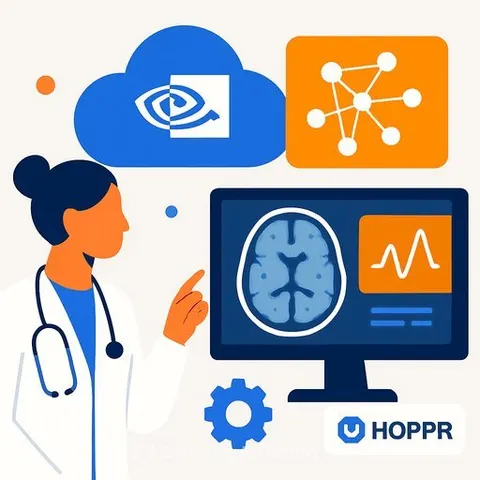
Nvidia partners with medical imaging startup to scale hospital AI systems
Chicago-based Hoppr is integrating Nvidia's AI systems into its medical imaging platform, marking the chip maker's latest push into healthcare operations. The partnership will add reasoning capabilities to Hoppr's existing image generation and text conversion tools, allowing hospitals to combine multiple models for overlapping tasks.
Hoppr founder and CEO Khan Siddiqui said the company already used Nvidia GPUs and approached the company to deploy its models as a next step. "Now our customers can cherry-pick what functionality they need," Siddiqui said. "They can take the finding model and then run it against the reasoning model."
Why this matters for medical imaging
Building AI models for medical imaging has traditionally taken 18 months to two years, Siddiqui said. That timeline includes data collection, infrastructure setup, and compliance work. Healthcare organizations typically build these systems on-premises to maintain control over how images are handled and processed.
Hoppr raised $31.5 million in Series A funding last June. The company provides a development platform for AI for Healthcare applications that must meet FDA and EU MDR requirements for software development standards, data handling, and data provenance.
Two models entering production
Nvidia's NV-Reason and NV-Generate models will power the integration. NV-Generate streamlines workflows by assisting with image interpretation, while NV-Reason adds analytical depth to imaging analysis.
David Niewolny, Nvidia's senior director and global head of business development for healthcare and medical, said the models have been downloaded more than 10,000 times since their October 2025 announcement. Companies like Aidoc are pursuing similar applications of Generative AI and LLM technology in medical imaging.
The infrastructure play
Niewolny framed Nvidia's role as foundational. The company's GPUs and AI systems provide the underlying layer that companies like Hoppr build on top of. "Moving it from the bench to the bedside-no longer is this just scientific research that's going to be published, this is something that's actually going to now have the ability to be scaled," Niewolny said.
He added that AI is "becoming an always-on capability that's going to be core to hospital infrastructure." Scaling these systems across healthcare organizations improves access to care and workflow efficiency while increasing GPU consumption throughout the ecosystem.