
AI news ·
Hospitality experts weigh where AI and robotics add value and where human presence must remain
Hotels and restaurants are deploying AI and robotics now, with early results including 89% labor reduction at fry stations and 20% faster room turnaround. The harder question is where humans must stay central.
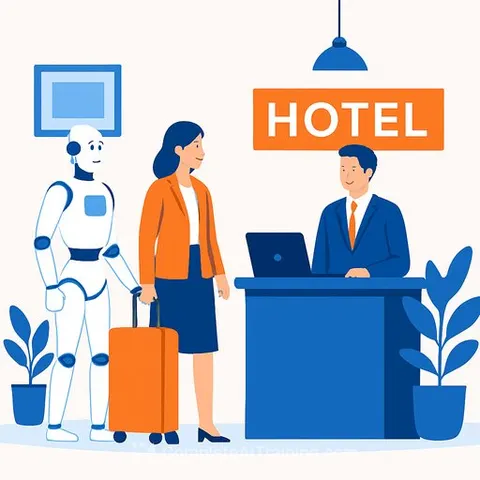
AI and Robotics Are Already Here. Hospitality Is Figuring Out Where They Belong.
Artificial intelligence and robotics are no longer theoretical in hospitality. Hotels and restaurants are deploying them today-in kitchens, back offices, and guest-facing roles-and the results are measurable. The question now is not whether these technologies work. It is where they should work, and where humans must remain central to the guest experience.
A group of industry leaders examined how AI and robotics are creating value in hospitality right now, where they fall short, and how the line should be drawn between automation and human service. Their answers reveal an industry in transition, not crisis.
Where AI and Robotics Add Real Value
The highest-value applications cluster in three areas: repetitive physical tasks, back-office intelligence, and data-heavy decisions that would consume hours of human time.
In commercial kitchens, frying stations are the obvious target. The work is dangerous, difficult to staff, and inconsistent. One operator deployed an AI-powered fry station robot and saw an 89% reduction in labor needed at that position, over 100 baskets per hour, zero fry station injuries, and 90% employee favorability. The robot freed kitchen staff to focus on quality control and customer interaction instead of standing at a dangerous station.
Housekeeping optimization shows similar gains. Predictive tools that sync cleaning schedules with check-out patterns and staff availability cut room turnaround times by around 20% at early adopters. Delivery robots like Relay handle towel and toiletry runs 24/7, replacing 1.5 to 2 full-time positions with payback in 6 to 18 months.
Revenue management is where AI delivers perhaps the most consistent financial lift. Hotels generate massive volumes of data-booking pace, competitor rates, event calendars, demand signals-that no human team can process in real time. AI models that synthesize all of that into pricing and strategy decisions are producing measurable gains in RevPAR index against competitive sets. One multi-unit restaurant operator saw an average sales-per-labor-hour increase of $11 across locations after deploying an AI revenue platform.
Guest communication automation handles the volume problem. AI concierges answer routine questions-restaurant hours, valet costs, pet policies, Wi-Fi access, late check-out requests-in multiple languages, freeing front desk staff to build relationships with guests instead of repeating the same answers 40 times a day.
Food waste reduction through computer-vision systems has helped resorts and cruise lines cut buffet waste by roughly 50% within months. That directly improves margins and sustainability metrics.
Where AI Still Falls Short
Automation struggles anywhere that requires genuine judgment, emotional intelligence, or creative problem-solving. Complex service recovery-a bereavement, a botched anniversary stay, a frustrated business traveler after a four-hour flight delay-requires improvisation and empathy. AI cannot yet do that work credibly.
Deep personalization on property remains difficult. Many robots can route a guest to the gym but cannot flexibly recommend local experiences based on context. Humanoid robots at front desks still make many guests uncomfortable. Self-check-in kiosks are increasingly accepted, but the warm welcome still comes from a person.
Guests remember how they were treated. They remember whether someone listened, whether someone cared, whether someone stepped in when something went wrong. No technology currently substitutes for that.
Cost also remains a barrier. Many AI-driven solutions-automated phone systems, RFP management tools, robotics-are still too expensive for smaller operators unless built internally, which introduces data security and governance concerns.
The Labor Context Matters
Before debating whether automation should replace humans, acknowledge this: the hospitality industry faces a severe and persistent labor shortage. In most cases, operators are not choosing between a robot and a person. They are choosing between a robot and an unstaffed station.
That context changes the entire conversation. Automation that absorbs dangerous and undesirable work frees people to do higher-value roles more connected to the guest experience. When a kitchen worker is removed from the fry station, they can focus on quality control, training, and customer interaction. That is a better job.
Research shows that 65% of workers with predictable schedules are more likely to stay with their employer long term. AI-powered scheduling platforms that give frontline employees visibility into how their work connects to business outcomes, and that recognize performance, directly address chronic turnover. For an industry where turnover regularly exceeds 40%, that matters.
Where the Line Should Be Drawn
Automate the invisible. Humanize the visible.
Automation belongs in tasks that are repetitive, rules-based, low emotional stakes, and reversible if they fail. Sending a late checkout link, delivering water, allocating rooms, forecasting demand-speed and accuracy matter more than conversation.
Automation does not belong at moments of emotional consequence. A guest checking in at 11 PM after a four-hour flight delay does not want a kiosk. A guest dealing with a bereavement does not want a chatbot. A family celebrating an anniversary wants a person who understands the moment.
Most guest journeys contain 30 to 40 micro-moments. The right strategy is to automate the routine 28 and aggressively staff the four or five that determine whether that guest returns, brings the next group, or writes the review that books five future stays.
On the revenue and operations side, the line is nearly opposite. There is very little human judgment that consistently outperforms a well-trained AI model for pricing decisions, demand forecasting, or rate strategy. Human intuition in those contexts is often biased-anchoring to last year's numbers, over-weighting a single large contract, discounting under short-term pressure. Letting AI carry that load while commercial teams focus on strategy and relationship management is where smart operators are heading.
What Happens to the Workforce
The honest math: total hotel headcount will decline. A property running well on 65 associates today may run as well on 45 in 2030. But those 45 will be better paid, better trained, and concentrated where they actually move the needle.
The jobs are getting better, not disappearing. Clerical roles, top-of-funnel recruiting, reactive guest communication, and basic revenue management execution are compressing fast. These are pure intelligence work already partially outsourced, and substitution is frictionless.
Front office and reservations staff will spend less time on transactional volume and more time on exception management and elevated service. Revenue managers are already transitioning from rate-grid management to interpreting AI insights and translating commercial strategy across the organization. Their value lies in commercial judgment and communication, not spreadsheet management.
New roles are emerging that did not exist on a hotel org chart two years ago: AI orchestrators, exception handlers, agent supervisors, prompt operations specialists, data integrity managers. These will be standard within 24 months.
Mid-management ratios will widen. Each manager can credibly oversee more associates when AI handles the routine work below them. But that requires leaders who know how to turn better tools into better execution.
Two skills will separate high performers from the rest: data literacy and storytelling. Employees will need to read dashboards, understand forecasts, and make decisions with AI-generated insights. That becomes baseline competence. Their ability to connect with guests, anticipate needs, and personalize experiences becomes the differentiator for advancement.
The Adoption Gap Matters
Early adopters and late movers are already diverging. The technology is advancing fast enough that waiting to see what happens is a business risk, not a prudent strategy.
The strongest deployments are narrow and outcome-tied. Marriott's automated upgrade tool freed several hours of front-desk labor per property per day. EVA, Marriott's voice agent, reduced front-desk workload by roughly 58% at properties running it. Hilton's kitchen scales reduced food waste by 60% or more across about 200 hotels. Wyndham deployed AI agents handling guest services across roughly 7% of its global hotels in 2025.
Most operators have piloted ten things and gotten meaningful ROI on two or three. The differentiator is not which robot or model you bought. It is whether you had clean enough data and process discipline to measure what actually changed.
The Real Opportunity
AI is the first technology shift in 25 years that gives independent hotels and franchisees a credible path to take back distribution control from online travel agencies. Natural language SEO, content optimization for AI agents, conversational booking on owned channels, automated direct response-these were tools only the largest brands could afford to build. AI collapses that gap.
For hospitality professionals, the message is clear: these tools are not coming. They are here. The question is whether your organization is using them to make your people more effective, or whether you are waiting for a competitor to move first.
Learn more about AI for Hospitality & Events and how AI Agents & Automation are reshaping operations.