
AI news ·
Hotels with clearer signal intelligence will outperform those with more AI tools, author argues
Hotel leaders aren't short on data-they're short on the ability to act on it. The gap between collecting signals and making decisions is where operational performance is won or lost.
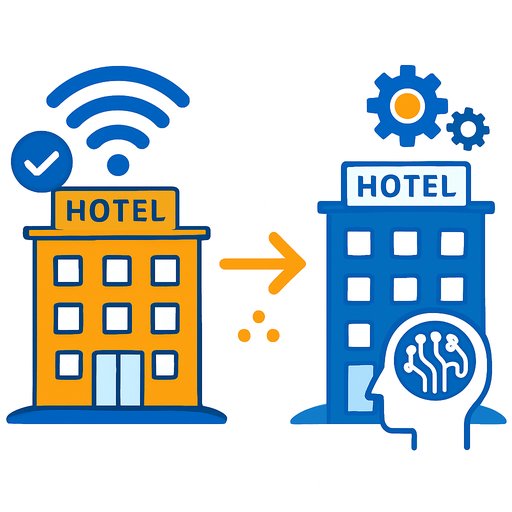
Hotel Leaders Face a Signal Problem, Not a Data Problem
General managers at hotels across the industry are drowning in information. Booking pace signals, guest sentiment data, staffing patterns, occupancy forecasts, channel performance metrics. The data exists. What is missing is the ability to turn that data into decisions they can act on before the shift starts.
This is not a data shortage. Hotels generate more data than ever before. The problem is interpretation. Most hotel leaders cannot reliably distinguish which signals matter most, which require immediate action, and which can wait. That gap between data collection and decision-making is where the real operational friction lives.
Signal Intelligence as Operating Infrastructure
A booking pace that shifts three weeks before a major local event tells a revenue manager something a static rate strategy will miss. A cluster of review complaints about breakfast service tells an operations leader something that a monthly report arrives too late to address. A staffing stress spike ahead of a high-occupancy weekend tells a GM something a reactive scheduling system will never surface in time.
Experienced operators have read these signals by instinct for years, through relationships and daily conversations with staff. AI changes the timeline. It surfaces signals earlier, more consistently, and across more data points than any individual can hold in their head.
Hotels that build signal intelligence as a core operating system-not a side project-make faster decisions, absorb demand swings more effectively, and create guest experiences that feel personalized because the team had the intelligence to act at the right moment.
Cloud Infrastructure Is Now Strategic, Not Optional
Most hotels in 2026 still operate with fragmented technology stacks. A PMS that does not talk to the CRM in real time. A revenue management system disconnected from guest communication platforms. A booking engine that captures intent signals but does not share them with operational systems.
When AI tools are introduced into this environment, they inherit the fragmentation. They can automate individual tasks and answer individual questions. They cannot produce unified operational intelligence because the data they work with has never been connected in the first place.
For independent and boutique hotels, the cloud transformation conversation has been treated as a future concern, a capital expense to revisit when margins improve. That calculation has changed. A hotel operating on legacy systems with siloed data now operates with blind spots that become more consequential as competitors around it become more intelligently driven.
Cloud infrastructure is no longer a technology decision. It is a strategic decision about whether a hotel intends to compete in the next operating era or defend its position in the previous one.
The Leadership Clarity Gap
The hospitality AI skill gap is consistently framed as a front-line problem. Housekeepers unfamiliar with scanning tools. Front desk agents struggling with new communication platforms. Revenue managers intimidated by dynamic pricing interfaces. These are real challenges, but they are symptoms of a deeper issue.
The leaders most paralyzed by AI right now are not those who lack technology skills. They are those who lack operational clarity about what AI is supposed to change for their specific hotel. They understand that AI matters. They know the shift is accelerating. What they are missing is a framework that connects technology choices to the outcomes they are responsible for: occupancy, RevPAR, guest satisfaction, staff retention, direct booking rate.
This clarity gap is a leadership problem, and it is becoming more urgent. The general AI market is moving faster than most hotel organizations can absorb. The hotels navigating this most effectively have not adopted more tools. Their leadership has developed a more confident relationship with AI as a decision-support system. They understand what signals their operation generates and why those signals matter. They can articulate what better intelligence would change about the decisions they make every week.
Independent Hotels Have a Different Competitive Space
Every major hotel brand and OTA is investing in AI as an efficiency and scale mechanism. They are automating transactions, reducing cost per interaction, and compressing operational overhead. That strategy works for organizations built for scale.
Efficiency at scale is not the competitive advantage available to boutique and independent hotels. The advantage independent hospitality has always held-and that AI now makes it possible to express more precisely than ever-is the ability to be more human, not less.
The future competitive advantage belongs to the hotel that uses AI to see its guests more clearly, respond to operational signals more quickly, and free its team to do the things no algorithm will produce. The unexpected gesture. The remembered preference. The moment of genuine recognition that makes a guest feel seen rather than processed.
While chains and OTAs compete for efficiency at scale, the boutique hotel with signal intelligence built into operations, unified technology infrastructure, and genuine AI literacy is competing in a different space entirely. One where the chains cannot follow because their scale is the constraint that prevents them from going there.
What Winning Hotels Look Like in Five Years
Hotels that win the next five years will operate with stronger signal intelligence, where the gap between data and decision is measured in hours rather than months.
They will have replaced fragmented legacy systems with cloud infrastructure where the PMS, CRM, revenue management system, and guest communication platform share context rather than operating in isolation. Their teams will have developed genuine AI literacy-not the ability to operate any specific tool, but the confidence to use AI as a judgment amplifier rather than a replacement for judgment.
Most importantly, their leadership teams will have made the central strategic decision of this era. To use AI not to become more like the automated systems competing on price, but to become more distinctive, more consistent, more intelligently human.
The operational clarity that AI provides is not a destination. It is a new operating layer that sits above disconnected systems and below the human judgment that still defines hospitality at its best.
Frequently Asked Questions
What is signal intelligence, and why does it matter for hotel operations?
Signal intelligence is the ability to interpret operational data in real time rather than simply collecting it. Most hotels already generate significant data across booking pace, guest sentiment, staffing patterns, and revenue performance. The problem is not the volume of data but the absence of a system that turns that data into decisions a GM can act on before the shift starts.
Hotels that build signal intelligence as a deliberate operating capability make faster decisions, absorb demand volatility more effectively, and create guest experiences that feel genuinely personalized because the team has the intelligence to act at the right moment. Learn more about AI Data Analysis to understand how to build this capability.
Why is cloud infrastructure now a strategic decision rather than a technology decision?
Because AI layered on top of disconnected legacy systems creates a more sophisticated version of the same confusion, rather than the clarity the hotel was trying to achieve. When a PMS does not share data with a CRM, when a booking engine does not connect to operational systems, and when revenue management operates in isolation from guest communication, no AI tool can produce unified operational intelligence from those fragmented inputs.
Cloud infrastructure is the foundation that makes connected intelligence possible. For independent hotels that have been deferring that conversation, the window to do so without competitive consequence is closing.
What does the hotel AI skill gap actually look like at the leadership level?
The hospitality AI skill gap is most commonly framed as a front-line problem. But the more consequential gap sits at the leadership level, where the missing ingredient is not technology skill but operational clarity about what AI is actually supposed to change for the specific hotel.
The leaders most paralyzed by AI right now are not those who lack technical ability. They are those who lack a framework connecting technology choices to the outcomes they are responsible for: occupancy, RevPAR, guest satisfaction, staff retention, and direct booking rate.
Explore AI for Hospitality & Events to develop the strategic clarity needed to guide your hotel through this transition.