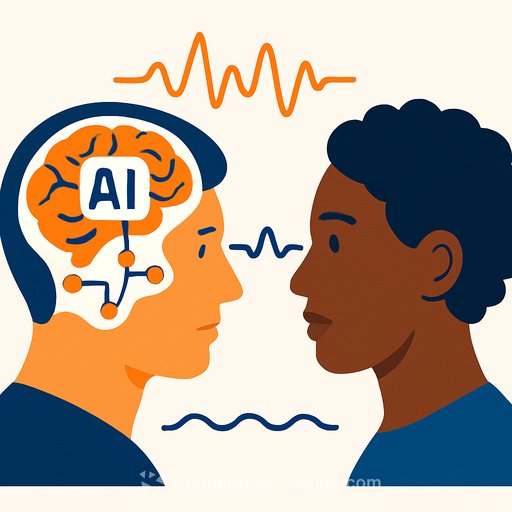
Researchers Use AI and EEG to Decode How We Perceive Faces from Different Races
Researchers at the University of Toronto Scarborough have combined artificial intelligence (AI) and brain activity data to explore why people often struggle to recognize faces from racial groups different than their own. This phenomenon, known as the Other-Race Effect (ORE), describes how individuals typically identify faces of their own race more accurately than those of other races.
By integrating AI-generated images with electroencephalography (EEG) readings, the studies reveal that visual distortions related to other-race faces are more deeply embedded in the brain than previously understood.
Key Findings on Facial Perception
One study, published in Behavior Research Methods, used generative adversarial networks (GANs) to reconstruct mental images participants formed of faces after viewing them. Two participant groups—East Asian and white—rated faces based on visual similarity. The AI-generated reconstructions showed that participants visualized same-race faces with greater accuracy.
Interestingly, faces from other races were often perceived as more average-looking and younger. This indicates that people tend to lose fine facial detail when mentally reconstructing faces from racial groups different from their own.
Insights from Brain Activity
A second study, featured in Frontiers, examined brain responses within the first 600 milliseconds of face viewing using EEG. The data allowed researchers to digitally rebuild how the brain processes facial features in real time.
Findings showed that brains respond to same-race faces with more distinct neural patterns, whereas other-race faces elicit less differentiated activity. This suggests the brain processes other-race faces more generally and with less detail.
One of the most striking observations was that other-race faces appeared not only more average but also younger and more expressive in participants’ mental images, even when the actual faces were not.
Implications for Reducing Bias and Improving Recognition
Understanding the neural basis of the Other-Race Effect could lead to practical applications in several areas. For instance, this research might inform methods to reduce implicit bias during first encounters across races. It could also contribute to enhancing facial recognition technologies and refining eyewitness identification accuracy.
Moreover, the approach shows promise for clinical use. By observing how emotional perceptions of faces differ in the brain, it may assist in diagnosing and treating mental health conditions like schizophrenia or borderline personality disorder where facial emotion recognition is impaired.
Looking Ahead
- The research was supported by a Natural Sciences and Engineering Research Council of Canada (NSERC) grant.
- Future work could focus on developing strategies to counteract perceptual biases during social interactions such as job interviews or cross-cultural communication.
- These insights also offer pathways to improve AI systems for facial recognition by incorporating how humans perceive and misperceive faces from other races.
For professionals interested in artificial intelligence applications in neuroscience and social cognition, these findings highlight valuable intersections between brain science and machine learning.
Explore more advanced AI learning opportunities at Complete AI Training.
Your membership also unlocks: