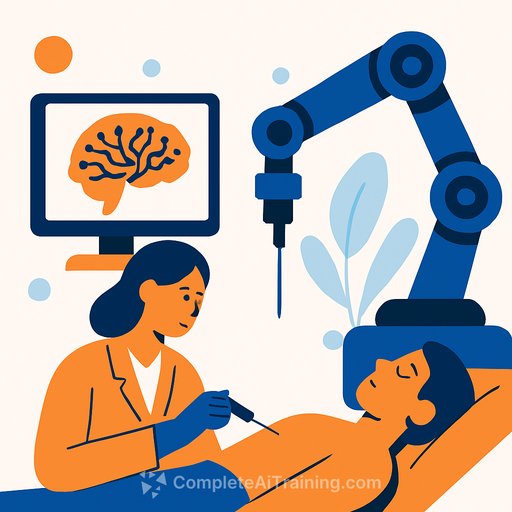
Is There a Place for AI in Placing Medical Needles?
The healthcare sector is facing a growing challenge: the demand for qualified medical practitioners and surgeons is set to double within the next decade. This surge is driven by an aging population and a faster retirement rate among professionals than the entry of new ones. Such trends increase pressure on both doctors and patients, prompting the search for innovative solutions.
Recent research highlights how artificial intelligence (AI) can assist in deploying medical needles inside the body, a critical part of many procedures. For years, surgeons have relied on imaging technologies like computed tomography (CT), ultrasound, and magnetic resonance imaging (MRI) to guide their actions. Now, advances in AI are creating opportunities for highly precise interventions where accuracy is crucial.
Targeted AI Integration in Needle-Based Procedures
AI is not about creating an all-knowing surgical robot but about integrating specific AI tools into the existing surgical workflow to improve particular tasks. The focus is on identifying where AI can be most useful in needle-based interventions and understanding how these technologies can complement human expertise.
By reducing the workload on surgeons and interventionalists, AI can help ease workforce shortages and reduce burnout. Some autonomous tools already outperform humans in certain tasks, expanding access to care in a system facing staffing challenges.
Four-Part AI-Guidance Framework
The research presents a clear framework for AI guidance in needle procedures, breaking it down into four components:
- Perceiving anatomy: Using imaging data to automatically identify anatomical structures and their geometry.
- Planning motions: Designing safe and efficient needle paths that avoid obstacles.
- Perceiving instrument state: Monitoring the needle’s position and condition during the procedure.
- Performing motions: Executing the planned needle movements with precision.
Each element of this framework operates along a spectrum from basic assistance to full autonomy, allowing for flexible integration depending on the procedure’s complexity and safety requirements.
Balancing AI Assistance and Human Oversight
The study stresses that AI in needle interventions is nuanced and should not be viewed as simply handing control over to robots. Instead, AI components can be introduced incrementally, with safeguards built in to ensure human supervision remains central.
This approach enables the creation of “guardrails” around AI use, minimizing risks while maximizing performance benefits. Applications include image segmentation, CT-based target identification, and planning steerable needle trajectories that curve around critical structures.
Advances in Surgical Robotics and Needle Technology
In practice, AI-augmented robotics are being developed to make surgical tools smaller, less invasive, and more precise. For example, robotic platforms allow instruments to enter the body through small ports and rotate around fixed points while maneuvering with fine dexterity via wrist-like mechanisms.
These steerable needles can access deep sites such as the brain or lungs, curving around blood vessels and other obstacles to reach targets safely. Enhanced image processing and AI guidance improve the instruments’ autonomy and effectiveness, whether operated independently or controlled by surgeons via consoles.
Addressing Healthcare Challenges with AI-Enhanced Tools
The integration of AI in needle placement aims to tackle several pressing healthcare issues:
- Alleviating workforce shortages by reducing per-patient workload.
- Lowering burnout rates among medical professionals.
- Improving patient safety through higher precision and consistency.
- Enabling less invasive procedures with better outcomes.
By focusing on narrowly defined tasks and including human-in-the-loop verification, these AI tools can be responsibly introduced across a range of medical interventions.
The research discussed here was published in Science Robotics. It was supported by the National Institutes of Health and the National Science Foundation.
Your membership also unlocks: