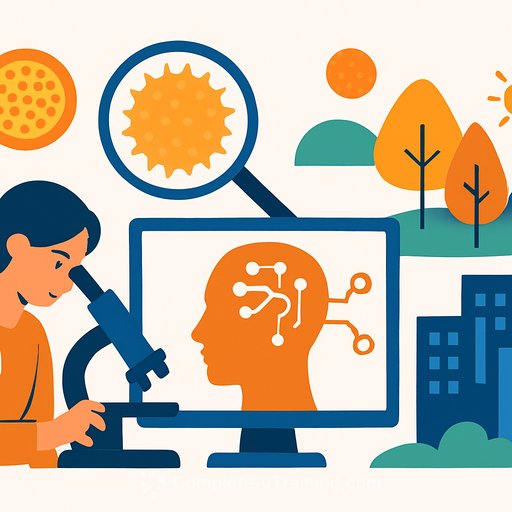
AI Advances Pollen Identification for Health and Ecology
Scientists have developed an artificial intelligence system capable of distinguishing fir, spruce, and pine pollen within seconds. This advancement offers practical benefits for urban planning, allergy management, and environmental research. The project involved collaboration among experts from the University of Texas at Arlington, the University of Nevada, and Virginia Tech, who trained nine machine learning models on microscope images sourced from the University of Nevada’s Museum of Natural History.
The leading AI algorithm outperformed human specialists in both speed and accuracy, while still depending on expertly prepared slides and ecological knowledge.
Sharper Pollen Data Enhances Urban Planning
More detailed pollen data allows urban planners to select tree species that reduce allergenic impact in sensitive locations such as schools, hospitals, playgrounds, and densely populated housing areas. According to Behnaz Balmaki, assistant professor at UTA, this information supports smarter planting decisions that can lower pollen exposure.
Real-time data streams powered by AI can also provide advanced warnings to residents about upcoming high-pollen days, helping communities better prepare.
Improved Allergy Alerts with Species-Specific Forecasts
Current pollen forecasts often aggregate all tree pollen, but the new AI model identifies which species contribute to pollen spikes on specific days. This level of detail enables healthcare providers to time allergy alerts and treatment recommendations more effectively, optimizing patient care during peak pollen seasons.
Insights into Historical Climate Through Pollen Analysis
Pollen preserved in lake sediments and peat bogs serves as a chronological record of past vegetation and climate conditions. Traditionally, identifying pollen to species level was time-consuming and limited to broader plant groups. AI accelerates this process by analyzing subtle microscopic differences, which previously required extended human examination.
Deep Learning Enhances Pollen Classification
Deep learning tools significantly increase the speed and precision of pollen identification, enabling large-scale environmental monitoring and detailed reconstructions of ecological changes. Automated systems could soon process thousands of slides, uploading results to open databases that help climatologists map historical droughts, heat waves, and recovery phases.
Applications in Agriculture and Ecosystem Monitoring
Pollen levels serve as indicators of ecosystem health. Variations in pollen production can signal water stress or soil degradation. Farmers monitoring these changes can receive early warnings of crop risks well before yield declines occur. Furthermore, shifts in pollen composition reveal vegetation changes, moisture levels, and past fire activity, providing valuable data for managing agricultural and natural landscapes.
Supporting Pollinator Conservation with AI
Pollinators like bees and butterflies depend on specific plants that bloom at precise times. The AI system’s ability to identify which plant species are present or declining informs conservation efforts aimed at protecting critical food sources and habitats for these insects. This insight helps maintain healthy meadows and supports broader ecological balance.
AI and Expert Collaboration in Pollen Testing
Researchers tested the AI models on decades-old samples of fir, spruce, and pine pollen. The algorithms learned to distinguish fine-scale features such as ridge patterns and pore counts. The best-performing model matched or exceeded the accuracy of experienced palynologists while operating at much faster speeds.
Nonetheless, careful sample preparation and ecological context remain essential. The team emphasizes that AI complements, rather than replaces, expert knowledge in pollen identification.
Future Directions: Expanding Species Coverage and Applications
The researchers plan to include images of oak, maple, grass, and weed pollen in the AI network. This expansion could lead to a comprehensive national atlas of species-specific pollen activity within a few years. Such data would enable scientists to monitor vegetation shifts following hurricanes, droughts, and warming trends that affect tree distributions.
For city planners, this technology offers plant selection strategies that mitigate respiratory problems. For farmers and ecologists, it provides ongoing environmental monitoring tools. As pollen seasons lengthen due to climate change, precise and rapid pollen identification will become increasingly vital for public health and environmental stewardship.
The study detailing this AI application is published in the journal Frontiers in Big Data.
Your membership also unlocks: