
AI news ·
How AI orchestration connects product teams across the full development lifecycle
Most product teams add AI tools one by one but stay slow because handoffs between design, engineering, and QA remain manual. AI orchestration coordinates the full delivery pipeline instead of improving isolated tasks.
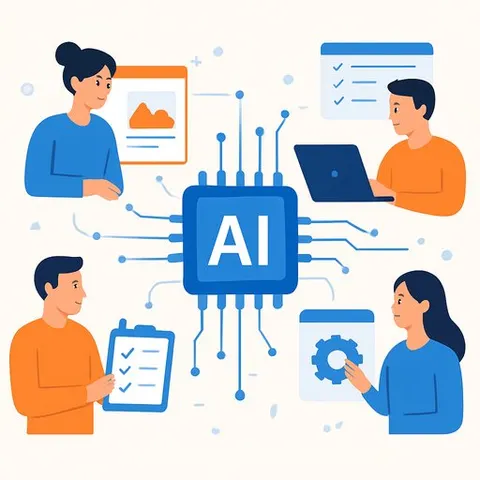
Why Product Teams Need AI Orchestration, Not Just AI Tools
Most product teams adopt AI tools incrementally - a code assistant here, a design generator there - then wonder why delivery remains slow. The bottleneck was never individual tasks. It was always coordination.
The problem surfaces at handoff points. Design, engineering, and QA each use AI independently, but the moments when work moves between disciplines stay manual and error-prone. Without a coordination layer, even strong tools produce fragmented outputs that require rework and create unclear ownership.
AI orchestration solves this by treating the entire product lifecycle as a single coordinated system. Instead of asking which AI tool to add next, teams start asking how to make the whole system work together.
What AI Orchestration Actually Does
AI orchestration is a coordination and control layer for product delivery. When multiple AI models, tools, agents, and humans work on the same product, something has to define how work runs, in what order, with which inputs, and what to validate before progressing.
An AI orchestrator acts as the execution engine within this layer. It translates high-level intent into structured tasks, routes them to the appropriate execution layer, maintains shared context across steps, and triggers human intervention when decisions require judgment.
The difference between AI for Product Development and AI-coordinated delivery is what actually ships. Isolated tools improve individual tasks. Orchestration improves the system.
How It Works Across the Product Lifecycle
Discovery: Research, assumption validation, and scope definition happen simultaneously rather than sequentially. This shortens analysis time while maintaining depth and accuracy.
Planning and prioritization: The system models different options, highlights dependencies, and surfaces risks early. Humans make final decisions based on complete context, not fragmented inputs.
Design and prototyping: AI generates wireframes, applies design system rules, and flags accessibility issues. Designers focus on user flows and edge cases while the system keeps everything aligned with the product spec.
Engineering: Code doesn't go straight to production. The system runs automated tests and architecture checks before human review, reducing rework and maintaining codebase consistency.
QA and compliance: Tests run automatically after every meaningful change. Compliance checks happen during development instead of at the end. Humans only review exceptions or unclear cases.
Release and iteration: Production data, errors, and user behavior signals feed continuously back into development. Improvements happen as part of the workflow, not after release.
Core Components That Actually Matter
A working orchestration platform needs task routing - deciding what goes to AI, what goes to humans, and under what conditions. It needs shared context management so information doesn't get lost between steps. It must connect to existing systems through APIs and tool integrations.
Human checkpoints are essential for decisions that require judgment. Full visibility - logs and tracking - lets every action be traced and reviewed. Failure handling prevents one broken step from disrupting the whole process.
Teams operationalizing this as a human-led framework - with senior experts owning architecture and decisions while AI Agents & Automation handle execution - report 25-30% higher efficiency within the same time and budget.
Common Failure Modes
Context loss between agents is the most frequent problem. Security exposure from misconfigured data access is the most serious. Tool sprawl, cost overruns from uncontrolled token usage, and accountability gaps when human ownership isn't clearly defined also derail projects.
Over-automation without accountability is where orchestration breaks down in production. A rising human review rate is an early warning sign worth investigating before it compounds.
Measuring What Works
Track delivery cycle time and handoff reduction - manual coordination touchpoints eliminated. Monitor defect rates in automated validation versus staging, cost per completed workflow, and human review rate.
A declining human review rate indicates the system is routing better. A rising one suggests the system needs adjustment.
When Teams Need Orchestration
Product teams should consider orchestration when multiple AI tools don't share context, when coordination creates more delay than execution, or when AI output quality is inconsistent across the pipeline.
Orchestration works in regulated environments - fintech, healthtech - when governance is built in explicitly. Audit trails, configurable human-in-the-loop checkpoints, and access controls can meet compliance requirements.
What to Look For
Evaluate platforms on human-in-the-loop configurability, deep observability, integration flexibility, and reliability under production load. Legibility - being able to understand what happened when something goes wrong - is a core requirement, not optional.