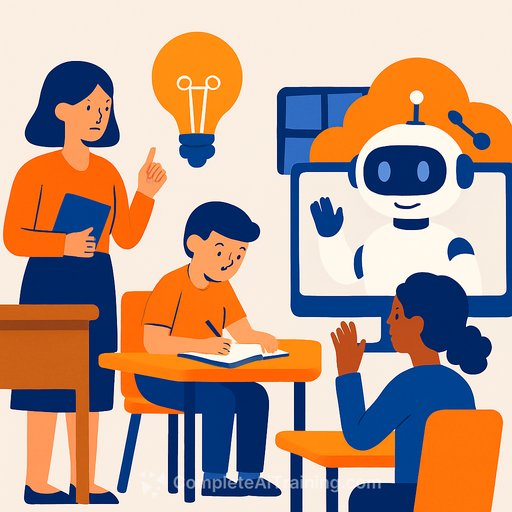
AI Can Challenge Students at Their Own Pace and Level
Tessa Eysink, Professor of Technology-Enhanced Learning and Instruction at the BMS faculty, focuses on intellectual giftedness and differentiation in primary education. In her inaugural lecture, she emphasizes the need for personal attention in teaching. Growing up in a family of educators, her interest in how people think and learn led her to study Psychology and Cognitive Sciences at Radboud University Nijmegen. Since 2023, she has been a professor at UT, committed to improving education through research and practical tools.
Multiple Intellectual Giftedness
Eysink’s expertise in cognitive science centers on learning, problem-solving, and language processing, with increasing attention on AI integration. She explores how to effectively challenge gifted students without isolating them and how teachers can manage differentiation in diverse classrooms. According to her, AI has untapped potential to support these efforts.
Customization Per Student with AI
She distinguishes between two types of differentiation:
- Convergent differentiation: different methods lead all students to the same learning outcome.
- Divergent differentiation: students may reach different outcomes, allowing gifted students to learn more without holding back the rest.
Eysink advocates for divergent differentiation, arguing that gifted students should not be limited to the pace of their peers. She sees AI as a valuable tool to provide tailored challenges, helping teachers deliver customized explanations and meet diverse needs while covering core objectives. This approach not only reduces teacher workload but also improves student understanding.
Digital Experiments
Her work often involves developing digital learning environments and simulations that promote inquiry-based learning. While concerns about excessive screen time exist, Eysink stresses that effective digital tools can deepen understanding in ways traditional methods cannot. For example, simulations can accelerate plant growth or safely demonstrate chemical reactions, offering experiences difficult to replicate in real life.
Digital and non-digital methods complement each other. Students might build electronic setups to learn about electricity, combining hands-on activities with digital simulations for a balanced approach.
Science Savviness
Eysink is also focused on teaching students to critically evaluate information and construct arguments. Activities such as formulating hypotheses and drawing conclusions help develop these skills, preparing students to engage thoughtfully in society.
A Misunderstanding About Gifted Children
There is a common misconception that gifted children require less support. Eysink stresses they still need guidance, just in a different form. They prefer less rigid structure but not complete freedom. By observing how students learn and the challenges they face, teachers can provide targeted support through differentiation.
Will AI Replace Teachers?
Eysink firmly believes AI will never replace teachers. The social interaction and personal connection between teacher and student remain essential for effective learning.
Inaugural Lecture: “The Pupil at the Centre”
Her lecture highlights the importance of focusing on the individual needs of students. She discusses how teachers’ roles and classroom collaboration can support this focus. Additionally, she points out the opportunities that technology, including AI, presents for education and informal learning.
For educators interested in how AI can support learning at different levels, exploring Complete AI Training offers valuable resources and courses on AI applications in education.
Your membership also unlocks: