HR Leaders Push Back on AI Agents as Employees
Major companies are stepping back from treating AI agents like workers with names, job titles, and performance targets. The shift reflects a growing realization that anthropomorphizing AI distracts from where it actually creates value.
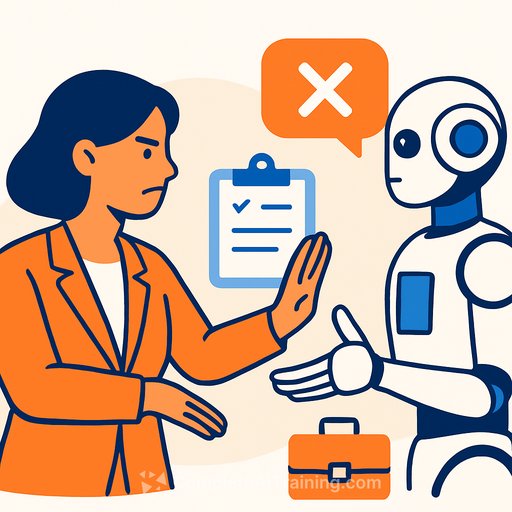
Nickle LaMoreaux, Chief Human Resources Officer at IBM, made the case bluntly at the WSJ Leadership Institute's Chief People Officer Summit: "Agents shouldn't have human names. They shouldn't be on org charts. And they shouldn't be given a specific job title."
IBM learned this lesson through trial and error. The company deployed agents named Harry, Hermione, Charlie, and Sherlock, but found itself focused on each agent's individual use cases rather than using them for large-scale process changes. "We learned this the hard way," LaMoreaux said.
Workflows, Not Individual Tools
The emerging strategy shifts focus from what each AI tool does to how work itself gets structured. Instead of building assistant-type agents that help with tasks like email writing, companies should integrate AI into enterprise workflows.
LaMoreaux described the difference: "This is you declaring, top down, in the organization: here's how employees are going to get customer support. Here's how we're going to run the promotion process. What's going to be automated. That workflow, that experience, is really what we should be focused on."
This approach treats AI as a technology to be managed like other systems, not as a parallel workforce. "Manage technology the way you've always managed technology for decades," she said. "Managing people is very different."
Accountability Remains With Humans
Even companies deploying AI at significant scale are drawing boundaries. BNY operates dozens of AI "digital employees" with company logins and human managers on its proprietary platform Eliza. But the company stops short of treating them as actual workers.
Microsoft's Chief People Officer Amy Coleman distinguishes between automating roles and automating tasks within roles. "I don't really think about roles and jobs that can be automated as much as I think about tasks in a job that can be automated," she said.
On whether AI could move into formal management structures, Coleman was cautious: "We are in that messy time of how we're going to figure it all out."
Box CEO Aaron Levie identified accountability as a hard boundary. "Accountability has to lie with humans. All our laws are set up to require that." Governance, compliance, and performance management frameworks still depend on human responsibility, regardless of how much work gets automated.
Levie acknowledged the scale of change underway: "This is the biggest shift we've ever seen in corporate work." The challenge now is moving beyond small experiments toward embedding AI into how work actually gets done.
For HR leaders, the takeaway is clear. Naming AI agents and assigning them to org charts may have helped with early exploration, but the real impact comes from redesigning workflows from the top down. The technology works best when it disappears into the process, not when it sits alongside employees with a name tag.
Learn more about AI for Human Resources or explore the AI Learning Path for CHROs.
Your membership also unlocks: