HR Professionals Report High Rates of Mental Fatigue From AI Tool Use
Human resources staff are among the most likely to experience "AI brain fry"-mental fatigue from overusing artificial intelligence tools-according to a Boston Consulting Group study of 1,488 workers at large companies.
The research, published by Harvard Business Review, found that 19.3% of HR and people operations staff reported experiencing this strain. Marketing employees had the highest rate at 25.9%, but HR ranked second across all job functions studied.
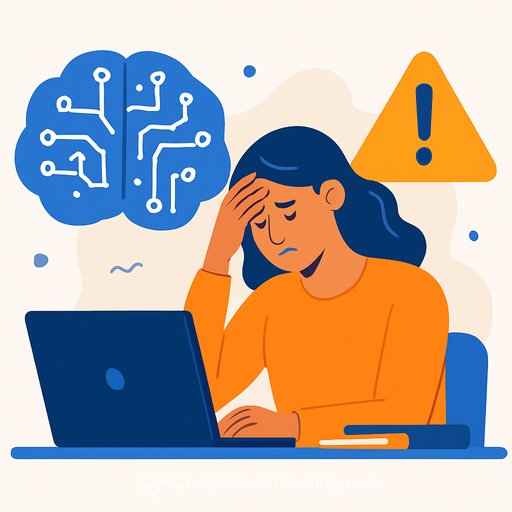
Researchers defined AI brain fry as "mental fatigue that results from excessive use of, interaction with, and/or oversight of AI tools beyond one's cognitive capacity." Workers described the feeling as mental fog, a "buzzing" sensation, or a "mental hangover" that slows decision-making and focus.
The Cost of Constant Monitoring
The study identified intensive oversight as the single most taxing pattern of AI use. Workers who had to constantly monitor, check, and correct AI outputs experienced the most strain.
An engineering manager quoted in the research described the effect: "I had one tool helping me weigh technical decisions, another spitting out drafts and summaries, and I kept bouncing between them, double-checking every little thing. But instead of moving faster, my brain just started to feel cluttered."
A finance director reported similar cognitive overload after using multiple AI tools to structure a major project. "I couldn't even comprehend if what I had created even made sense," the director said. "I just couldn't do anything else and had to revisit the next day when I could think."
Real Workplace Consequences
Employees experiencing AI brain fry showed measurable performance declines. They reported 33% more decision fatigue than those without the condition.
Error rates increased significantly. Workers with AI brain fry made 11% more minor errors like formatting mistakes and 39% more major errors with serious consequences.
The condition also affected retention. Among workers using AI without experiencing brain fry, 25% showed active intent to leave their jobs. Among those reporting brain fry, that share rose to 34%.
How Organizations Shape the Problem
The risk isn't simply about how much AI someone uses. How organizations structure that use matters more.
Researchers found that employees felt pressured when teams expected them to use AI or when organizations implied they should accomplish more work because of the technology. Workers at companies that valued work-life balance reported significantly lower mental strain, even with extensive AI use.
The study identified a specific threshold: "Our research suggests adverse productivity gains after the use of three AI agents at the same time," the researchers said.
What HR Leaders Should Do
The researchers recommend redesigning jobs so responsibility is shared between humans and AI, with clear limits on how many tools one worker oversees.
Leaders should set explicit expectations about AI's purpose and how it will affect workloads. "When organisations celebrate 'productivity gains' without clarifying workload implications, employees interpret this as work intensification," the report stated.
Organizations should also invest in training workers in problem framing, analysis planning, and strategic prioritization. This helps employees manage cognitive load more effectively.
Finally, companies need to monitor cognitive load as a job-related risk. "Cultures, teams, and leaders that prioritise cognitive thriving can expect to see better judgments, fewer errors, and higher retention rates for top talent," the researchers said.
For HR professionals managing these issues, resources on AI for Human Resources and the AI Learning Path for HR Managers can help build skills to address AI adoption challenges.
Your membership also unlocks: