
AI news ·
HR's role shifts from policy management to shaping organisational direction as AI reshapes work, says Jijivisha HR Solutions founder
HR leaders now sit at the center of business strategy, not on its edges. Retention, burnout, and AI transition directly drive company performance-and that's forced a fundamental shift in how organizations treat human resources.
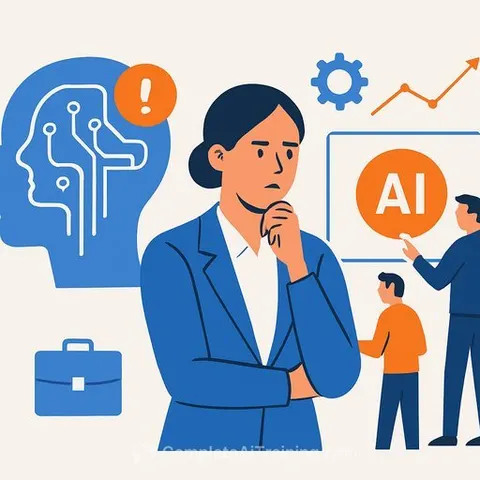
HR's Real Power: Moving Beyond Hiring to Shape Strategy
HR leaders have stopped fighting for a seat at the boardroom table. They're now central to decisions about organizational culture, workforce adaptation, and how companies survive automation. The shift reflects a harder truth: business problems have become human problems.
Retention, burnout, leadership trust, and AI transition are no longer HR department concerns. They drive company performance. That forces HR closer to core strategy-not because executives suddenly value people management, but because they have no choice.
What "Future of Work" Actually Means Right Now
The phrase has lost meaning through overuse. On the ground, it looks like distributed teams, AI-assisted workflows, and employees demanding more purpose and flexibility. But the real shift is deeper.
Organizations are moving from managing people as resources to understanding them through capability, emotion, creativity, and potential. Companies that thrive won't be the most technologically advanced. They'll be the ones that automate without losing their humanity.
The Wrong Way to Think About AI and Jobs
Most boardrooms approach AI as an efficiency play. Cut costs. Reduce headcount. HR leaders should think differently.
The question isn't "What jobs disappear?" It's "What becomes more uniquely human?" As automation increases, emotional intelligence, creativity, ethical thinking, and relationship-building become more valuable, not less. AI should elevate human potential, not simply shrink payroll.
Data should inform decisions, not replace human judgment. Metrics identify patterns. They can't measure trust, resilience, potential, or emotional complexity. The strongest leaders combine analytical intelligence with emotional intelligence.
Structural Changes Organizations Need Now
Traditional rigid job descriptions and linear career paths are becoming obsolete. The workforce of 2030 will be fluid-project-based, multi-skilled, cross-functional, and continuously learning.
Companies that build cultures of internal mobility, learning agility, and psychological safety will adapt faster than those relying on hierarchy. This requires moving from static structures to adaptive ones.
What Separates Transformational HR Leaders
Managers maintain systems. Transformational leaders shape environments where people grow and navigate change with confidence.
Culture isn't built through policies alone. It's built through trust, clarity, leadership behavior, and everyday human experiences. Transformational HR leaders influence belief systems inside organizations, not just processes.
The CHRO Role Is Becoming More Complex, Not Simpler
The Chief Human Resources Officer role isn't evolving into a Chief Culture Officer. That would be rebranding. Instead, it's becoming one of the most complex enterprise leadership roles because it sits at the intersection of business transformation, leadership capability, workforce strategy, AI adoption, and culture.
Culture directly affects innovation, retention, adaptability, and organizational performance. Today's CHRO plays many roles: business direction, understanding human psychology, managing inter-generational complexity, and navigating AI adoption.
What New HR Professionals Must Learn
Young HR leaders entering the field need to understand business strategy, technology, AI, analytics, organizational psychology, and change management-not just traditional HR functions.
But they must also retain empathy and human sensitivity in increasingly automated environments. That balance will define exceptional HR leadership in the coming decade.
The Three Skills That Matter Most
Creativity, empathy, and emotional intelligence. Leaders no longer need to project certainty or have all the answers. People expect honesty, empathy, and humanity instead.
The last five years showed that adaptability and continuous learning matter far more than control. That's the leadership lesson that won't change.
For HR professionals building expertise in this space, AI for Human Resources and the AI Learning Path for CHROs provide structured guidance on strategy and implementation.