
AI news ·
Huawei overtakes Nvidia in China's AI chip market
Huawei will take 50% of China's AI chip market this year as Nvidia's share falls to 8%. This split creates a two-track hardware market for enterprise sales teams.
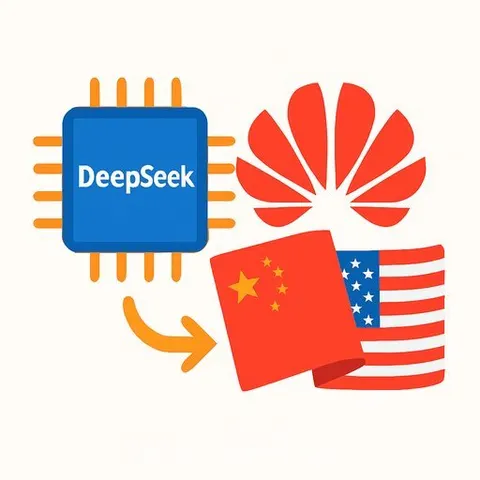
Huawei has pulled even with Nvidia in China's AI chip market and is on track to command roughly 50% of domestic sales this year, while Nvidia's share is projected to shrink from about 40% to just 8%, according to equity research firm Bernstein. For sales teams who sell into or compete with Chinese tech, the shift rewrites the hardware landscape that underpins the region's generative AI and LLM boom.
Jensen Huang, Nvidia's CEO, acknowledged the reversal during a recent interview with The Associated Press. "Well, we were in China for 30 years, and before the export control banned Nvidia out of China we had about 95% market share, and so we were competing just fine," he said. "We have to have, number one, make sure that we have national security and that we protect our nation, but we also simultaneously should go and compete and grow our technology industry and maximize our exports."
Huawei leads the domestic AI chip market
Since the U.S. barred Huawei from buying the most advanced chips and chipmaking gear in 2019, Chinese semiconductor firms have raced toward self-sufficiency. Huawei's Ascend 950 series, its most advanced commercial AI chips, is now seen as roughly comparable to Nvidia's H200, analysts say. A report from Bernstein estimates that Huawei's market share in China's AI chip sector will climb to about 50% this year, while Nvidia's drops to around 8%.
Antonia Hmaidi, a semiconductor analyst with the Mercator Institute for China Studies, put it bluntly: Nvidia "has definitely lost significant ground to Huawei, which (now) leads domestically." The shift accelerated after Beijing began encouraging the use of locally designed chips, even as Nvidia secured a reprieve to sell its H200 chips under Trump administration trade terms.
Last September, Huawei said it was deploying some of the world's most powerful AI computing clusters, combining thousands of chips despite relying on Chinese-made semiconductors. He Tingbo, head of Huawei's semiconductor business, said at a recent event: "We have found pretty good solutions." She added, "Who can walk faster? Huawei or other companies? I don't know the answer. I think only time will tell."
Nvidia's role remains critical despite restrictions
Even with Huawei's rise, demand for AI chips in China still outstrips supply. Recent smuggling cases involving Nvidia's chips underscore the appetite for its technology. Chinese universities, big tech firms, and cutting-edge projects like Deepseek - whose latest V4 model was adapted for Huawei's Ascend chips - continue to rely on Nvidia hardware for training and R&D.
Nvidia designed its H20 chips with reduced computing power to comply with U.S. export rules, but sales of those chips in China have been declining, according to Brady Wang of Counterpoint Research. The company has not sold H200 chips in China, and Huang told shareholders it had "yet to generate any revenue, and we are uncertain whether any imports will be allowed into the country." Nvidia's global revenue, however, keeps climbing: it expects around $91 billion in the May-July quarter, excluding China data center compute revenue.
Huawei's global ambitions and the sales implications
Huawei already operates in 170 countries and regions as the world's largest telecom equipment supplier, and its chip business is following suit. As China's advanced chip manufacturing capacity grows and pricing becomes more competitive, Huawei could gain share in markets like Southeast Asia, Wang said. "China's strategy of pursuing technological self-sufficiency - and eventually exporting its technologies - is unlikely to change regardless of whether Nvidia can sell its chips in China."
For now, China's production capacity for advanced chips still falls short of domestic demand, limiting near-term export volumes. But the direction is clear: Huawei is building a parallel supply chain that sales leaders outside China will need to understand, price against, and position alongside.
Why this matters for sales
The reshuffling of market share in the world's second-largest economy changes the competitive set for anyone selling AI infrastructure, cloud services, or enterprise software that depends on chip performance. If Huawei's Ascend chips become the default inside China, sales teams targeting Chinese enterprises will need to align their solutions with that ecosystem. For those selling Nvidia-based stacks, the window is narrowing to high-end research and restricted segments. The lesson from Bernstein's numbers is not that Nvidia is fading globally - it is that regional self-sufficiency is creating a two-track market, and your sales strategy needs to reflect which track you are on.