IIT Roorkee Develops AI Model to Read and Convert Ancient Modi Script
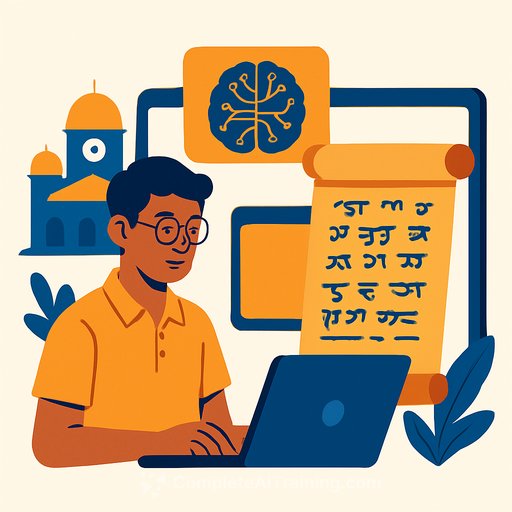
The Indian Institute of Technology (IIT) Roorkee has created the first Artificial Intelligence (AI) model capable of transliterating the historic Modi script into the Devanagari script. This breakthrough enables the conversion of unseen Marathi text written in Modi script into Devanagari, facilitating digitisation and academic research.
Transliteration involves converting text from one writing system to another while preserving the original language's sounds. The Devanagari script is widely used for languages such as Hindi, Sanskrit, Marathi, and Nepali, making this development especially valuable for scholars and educators.
Understanding the Modi Script
The Modi script was used predominantly for writing Marathi during medieval times. It appeared in land records, property documents, and texts related to yoga and medieval science. According to IIT Roorkee, around 40 million Modi documents remain untranslated due to the limited number of experts capable of reading this script and converting it into English or Devanagari.
Transliterating these documents can unlock important insights into India's medieval history and scientific achievements.
Challenges in Building the AI Model
Developing an AI model for Modi script posed significant challenges. The script's cursive style involves drawing letters connected by a horizontal line, which complicates character recognition. Variations in handwriting styles, angular strokes, broken lines, and blurring further hinder accurate reading.
Another major obstacle was the limited size of the dataset available for training the model. With only about 2,000 paired images of Modi script and corresponding Devanagari text, the AI had to learn complex patterns from relatively few examples.
Improving the Model Further
The current dataset includes documents from three medieval periods: Shivkali, Peshwekali, and Anglakali. Expanding this dataset to include texts from other historical periods such as Adyakalin and Yadavkalin could improve the model’s accuracy and reduce overfitting, where the AI performs well on known data but struggles with new content.
Enhancing this AI model opens doors for deeper exploration of historical documents and supports digitisation efforts that preserve cultural heritage.
For professionals in education and research interested in AI applications, exploring related courses can provide valuable skills. Visit Complete AI Training to learn more about available AI courses.
Your membership also unlocks: