
AI news ·
Illinois schools update policies as cyberbullying law adds AI-generated deepfakes
Illinois requires all school districts to update policies against AI-generated cyberbullying. A survey shows 40% of K-12 students are affected by sexually explicit deepfakes.
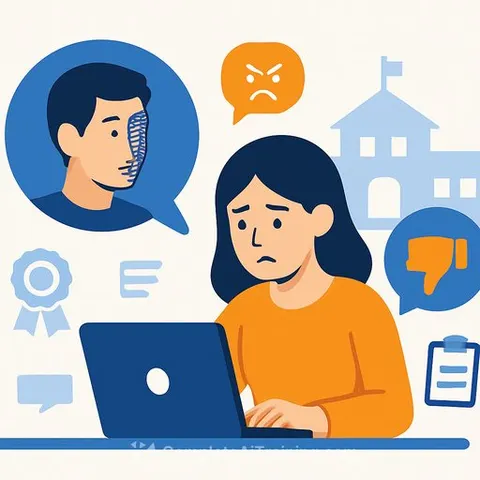
Effective July 1, Illinois expanded its legal definition of cyberbullying to include AI-generated digital replicas, requiring all school districts to update their policies. The mandate responds to a growing number of incidents in which students use artificial intelligence to create sexually explicit deepfakes of classmates-a problem that a 2024 survey revealed affects 40% of K-12 public school students.
State guidance and district responsibilities
Also by July 1, the Illinois State Board of Education was required to develop statewide guidance on artificial intelligence in schools. That guidance, expected before the 2026-27 school year, will address AI-generated false representations of individuals. ISBE press secretary Lindsay Record said that while the agency develops recommendations, "local policies, procedures and responses to specific incidents are determined at the district and school level." The Illinois push is part of broader AI for Education policy discussions happening as schools confront generative AI's impact on student safety.
A real-world incident in Lake Zurich
Earlier this year, Lake Zurich High School administrators dealt with a case where students created sexually explicit AI images of classmates. After reporting it to police, the district launched student and family education initiatives on online safety and responsible technology use. Jean Malek, executive director of communications for Lake Zurich Community Unit School District 95, said the district will continue "integration of explicit teaching opportunities for all students regarding safe, responsible technology usage" this coming school year.
Schools get clearer language on AI harm
Scott Rowe, superintendent of Township High School District 214, said the new law provides important clarification by naming unauthorized AI-generated digital replicas as a form of harm. "The message is clear," Rowe said. "AI does not remove responsibility." The law gives districts clearer language for policies, student expectations and family conversations, he added.
Under state law, AI-generated sexual images that appear to depict minors may be prosecuted under child pornography and related obscenity statutes. Depending on the circumstances, creating, possessing or distributing such images can result in felony charges. The new school-focused legislation does not change those existing criminal laws.
Widespread student awareness, low teacher readiness
The Center for Democracy & Technology survey also found that many schools have not proactively addressed AI-generated sexual imagery. More than 60% of teachers reported their school had not shared policies or procedures on the issue. Laura Tierney, founder of The Social Institute, said Illinois is taking a step in the right direction by acknowledging educators' role alongside law enforcement. "Legislation alone won't solve the spread of this. With legislation has to come education on the topic, and Illinois schools now have a legal obligation to address AI-generated cyberbullying," Tierney said.
Tierney noted that most students are well aware deepfakes are hurtful but might not fully understand how to support friends when images circulate. "I think this is an opportunity to coach towards the positives rather than solely scare students with the negatives," she said. "The reality is that it's still going to happen. So how can we help students make positive choices?"
Speed, realism, and the Whac-A-Mole challenge
Rowe said the biggest challenges for schools are speed, realism and reach. Images can spread quickly, and students may not know whether content is real or fake. "AI-generated content may be artificial, but the harm it causes can be very real," he said. He added that students do not have to create the original content to contribute to the harm-sharing or forwarding it can extend the damage and result in school consequences or, in some cases, legal ones.
Debra Jacobson, general counsel of the Illinois Association of School Boards, described the situation as a "bit of a game of Whac-A-Mole" because technology evolves quickly and students often stay ahead of adults. "Kids are often way ahead on technology and what they're doing with it so that can contribute to the challenge," Jacobson said. "I think the trend has just been accelerating."
Why this matters for Education professionals
The Illinois law requires schools to have policies against AI-generated cyberbullying, but policy alone will not stop harmful behavior. Educators must help students understand the consequences of creating and sharing such content, and they need the curriculum to do it. Programs like AI for Teachers provide digital literacy resources that equip teachers to guide students toward responsible technology use, reinforcing the positive coaching Tierney advocates.