
AI news ·
India reaffirms human-led AI approach at e-governance conference
India is putting human-led AI at the center of its digital government strategy. The 29th e-Governance conference adopted the Jaipur Declaration and presented 17 awards.
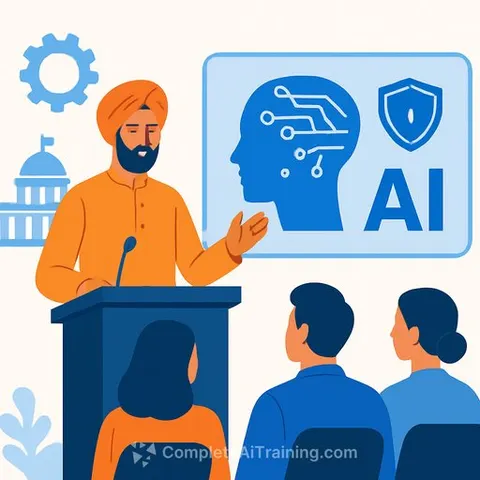
India will place 'Human-led Artificial Intelligence' at the center of its digital government strategy, Union Minister Dr Jitendra Singh said on 5 July 2026, as the 29th National Conference on e-Governance adopted a declaration setting a roadmap for AI-enabled, citizen-centric governance. The move locks AI into the country's long-term public sector transformation and establishes human oversight as a core design principle.
The conference, held in Jaipur under the theme 'Viksit Bharat 2047: AI-enabled, Data-driven and Secure Digital Governance', concluded with the Jaipur Declaration and the presentation of 17 National e-Governance Awards 2026. The awards recognized digital initiatives from ministries, states, local bodies and research institutions that improved public service delivery.
Jaipur Declaration sets long-term AI governance roadmap
The Jaipur Declaration outlines a strategic framework for AI-enabled governance that is secure, citizen-centric and accountable. It marks a shift from isolated pilots to a whole-of-government approach, reinforcing a national commitment to AI for Government across central and state administrations.
Human oversight as a non-negotiable foundation
"AI is no longer optional for governments," Singh said, adding that its success depends on responsible deployment that strengthens transparency, accountability and public service rather than replacing human judgement. He argued that AI should enhance institutional capacity while keeping human responsibility intact. The minister's emphasis on ethics and constitutional values was echoed throughout the conference sessions.
Multilingual AI and citizen-facing services scale up
Singh highlighted several flagship programmes already reshaping government-citizen interaction. The Centralized Public Grievance Redress and Monitoring System (CPGRAMS) and the multilingual chatbot SAMADHAN DIDI, built with the BHASHINI language platform, aim to make grievance resolution faster and more accessible. Other initiatives-the National e-Governance Service Delivery Assessment, Mission Karmayogi for civil service reform, and the IndiaAI Mission-are designed to raise the efficiency and reach of digital public services.
Beyond technology: building capacity and infrastructure
India's strategy extends well beyond software deployment. Singh said the 2047 development vision depends equally on administrative reform, secure Digital Public Infrastructure, and systematic capacity building for civil servants. This focus on human readiness reflects a broader recognition that technology alone cannot deliver accountable governance. Structured training programmes, including an AI Learning Path for Policy Makers, are becoming essential to equip officials with the skills to design, procure and oversee AI systems responsibly.
Why this matters for government professionals
The Jaipur Declaration signals that AI will soon become part of everyday workflows in grievances, service delivery and internal administration. Public servants will need to move beyond passive awareness toward active oversight-understanding how AI models reach decisions, where human intervention is required, and how to maintain citizen trust. The emphasis on ethics and training means departments may begin funding AI literacy programmes, and career progression in policy and administration could favour those who can manage AI-augmented processes. The timeline is not distant: Viksit Bharat 2047 milestones are already shaping departmental priorities.