
AI news ·
Indian higher education shifts from AI bans to integration in classrooms and examinations
Since 82% of Indian students use generative AI, universities dropped detection tools. They are redesigning exams to test critical thinking and prompt engineering.
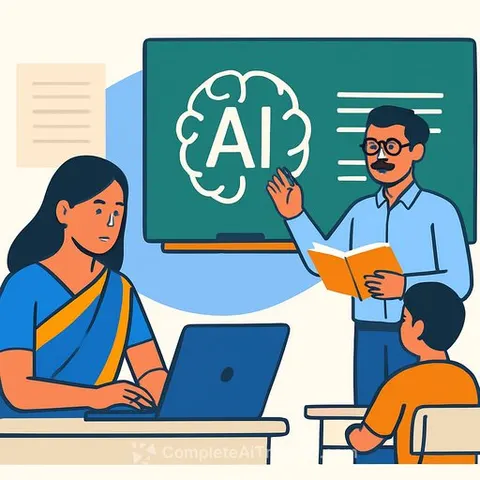
An overwhelming 82% of Indian college students now use generative AI for coursework, homework, and test preparation, according to a 2026 survey. The figure pushes far beyond the 62% global average and signals that AI has become a daily baseline utility for students. Recruiters are responding in kind - they now expect AI fluency as a baseline skill for entry-level positions, pushing higher education institutions to embed AI not just into syllabi but directly into pedagogy and assessment.
This shift forces an uncomfortable question onto academic administrators: should students be allowed to use AI in classrooms and examinations? The answer emerging from early institutional experiments is not a simple yes or no, but a wholesale redesign of what gets tested and how.
The stakeholder tensions driving policy
Students treat AI platforms as 24/7 personalised smart assistants, but their relationship with the tools carries operational confusion. Many admit they struggle to verify whether an AI-generated answer is correct. A significant portion of mental effort goes toward digital camouflaging - masking AI assistance so it reads as original work. Teachers face a parallel anxiety. AI has become "the easiest mechanism for academic malpractice ever invented," capable of generating plausible-looking citations, fake experimental data, or entire group projects in seconds.
The traditional take-home assignment is dead. When a syntactically perfect essay can be generated in moments, grading rubrics built around final outputs collapse. But detection alone is a losing race. "Every new AI detector eventually meets an even sharper evasion tool," the pattern shows. Educators harbour a deeper worry: the erosion of students' critical thinking abilities when AI handles the lower-order cognitive work.
For academic administrators, the dilemma tightens around code of conduct enforcement, infrastructure scaling, and cybersecurity risk. Policymakers, meanwhile, recognise that blanket AI bans will produce graduates unemployable in AI-driven workplaces. Across all stakeholder groups, the most consistently cited obstacle is "not a principled opposition to AI but a vacuum of clearly communicated policy and guidelines."
What the early adopters learned
Global universities that moved first on AI integration have drawn clear lines: AI belongs in the syllabus, but assessment must change. Arizona State University, Wharton, and Oxford deployed campus-wide ChatGPT Edu access for guided reflection projects and language-practice tasks. The University of Michigan built a secure, custom, privacy-compliant AI platform for its entire community.
Indian institutions have taken the experimentation further. The IIMs pioneered AI-co-piloted case studies where students query large language models for competitive research, market analysis, and financial projections. The grade does not rest on the final answer. Students are evaluated on their ability to critique AI outputs, spot structural hallucinations, and defend their strategic conclusions in a viva voce before a faculty panel.
IIT Madras integrated AI tools into foundational coding courses, shifting the focus from memorising syntax to mastering system logic and computational problem-solving. IIIT Delhi and IIM Nagpur now allow large language models in select examinations and assignments - on one condition. Students must submit the prompts they used alongside their answers.
Three lessons have solidified. Absolute bans fail because students bypass campus firewalls through private networks and mobile devices. Bans drive usage underground and create unequal access where tech-savvy students gain an edge. Assessments must evaluate the cognitive journey - Prompt Engineering strategies, critical analysis of outputs, and the ability to defend an approach interactively. And institutions must invest in secure, closed AI instances; publicly available commercial tools expose intellectual property and student data to exploitation.
Rebuilding assessment around thinking
If active engagement is the goal, prompt engineering is the discipline that externalises thinking. Students learn to specify context, request stepwise reasoning, assign the model a persona, and constrain the output format. A vaguely specified prompt is among the most common causes of AI hallucination. Teaching precise, well-constrained prompting therefore functions as error prevention, not merely a productivity trick.
Bloom's taxonomy offers a useful map. Generative AI excels at the lower rungs - recalling facts, summarising, producing first drafts. The argument follows that classroom time and assessment weight should shift almost entirely to the top three levels: applying, analysing, evaluating, and creating. Used well, AI becomes a sparring partner for higher-order work. A student can ask it to defend a counter-argument or stress-test a business plan, then must evaluate, correct, and improve what comes back. IIM Sambalpur's pilot uses an AI platform to score live MBA case-discussion participation against Bloom's six cognitive levels, returning detailed feedback on where each student's contribution sat on the ladder.
The teacher training gap
Students cannot be expected to use AI responsibly if teachers do not understand how the technology works. Training educators is the single most critical step. Institutional frameworks must target three domains. Teachers need rigorous technical and prompt literacy workshops - they must understand what happens inside a large language model and why models hallucinate data with high confidence. They need to learn sophisticated prompt frameworks and retrieval techniques.
Second, teachers must master AI-resilient assessment design. This means crafting assignments that machines cannot easily solve: hyper-local contexts, contemporary case studies occurring after a model's data cutoff, or multi-stage workflows where students submit initial handwritten concept maps, detailed prompt logs, and a final critical synthesis.
Third, training must emphasise AI ethics and bias mitigation. Educators must learn to identify systemic gender, racial, and cultural biases embedded within Western-trained models and pass that critical scepticism to students. The classroom must treat AI as an analytical partner rather than an unexamined oracle. Integrating AI for Education effectively starts with the teaching faculty, not the student body.
How other nations are governing AI in classrooms
Developed nations have moved from reactive anxiety to proactive governance. The European Union's AI Act classifies AI systems in educational institutions as "high-risk," legally mandating human oversight, algorithmic transparency, and data protection. Updated regulations place mandatory AI literacy obligations on institutions, requiring that both educators and students understand how these models function.
Singapore embedded an AI-in-Education framework into its Ministry of Education's Masterplan 2030, deploying custom, guided AI tools directly into the national student portal. Australia uses curriculum-aligned AI sandboxes designed to prompt critical thinking and error validation. The AI Assessment Scale, developed by Perkins, Roe, and Furze, sets out five graded levels of permitted AI use - from "No AI" through to full "AI Exploration" - that a teacher chooses deliberately for each task. The scale is designed to start an explicit conversation about appropriateness rather than catching violations after the fact.
Why this matters for educators
The question confronting Indian higher education is not whether AI should be allowed in classrooms and exam halls. It is whether the transition gets managed with proactive vision or reactive fear. The path forward requires shifting resources away from detection arms races and toward building advanced critical thinking, re-engineering assessment methods, and providing deep training for teaching faculty. For educators on the ground, the immediate takeaway is practical: the institutions that produced the strongest outcomes did not attempt to hold AI at the door. They redesigned the room so that AI could walk through it openly - and students were judged on what they did with it, not whether they used it.