Indian Scientists Build AI Tool to Decode Disordered Protein Binding
January 19, 2026
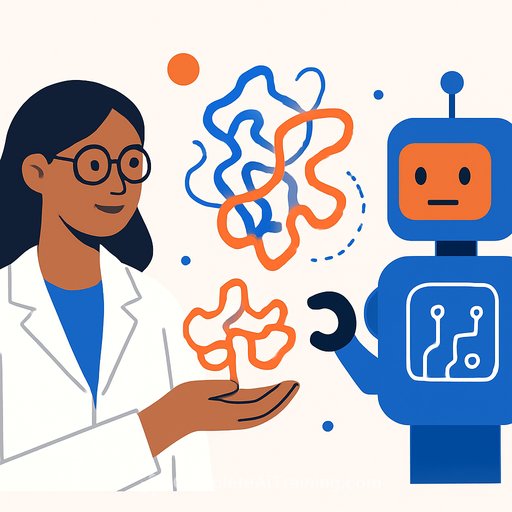
Researchers at the National Centre for Biological Sciences (NCBS), under the Tata Institute of Fundamental Research (TIFR), Bengaluru, have introduced Disobind-a deep-learning tool that predicts how intrinsically disordered proteins (IDPs) engage their partners. It tackles a long-standing blind spot in molecular biology and opens up direct routes for hypothesis generation in disease research and target discovery. For related work on AI-driven hypothesis generation and tool development, see Research.
Why IDPs matter
Most proteins adopt stable 3D structures. IDPs do not. Their flexible regions control signalling, gene regulation, protein quality control, and help form biomolecular condensates. That same flexibility makes them hard to analyse with traditional structure-first methods.
What Disobind does
Disobind scans protein sequences and predicts which regions of an IDP are likely to bind a specific partner. It leverages protein language models trained on millions of sequences, needs no structural templates or sequence alignments, and, crucially, conditions its predictions on the binding partner.
In practice, that means you can map interaction-prone motifs earlier, prioritize experiments, and reduce cycles spent on low-probability constructs.
Performance and benchmarking
The team, led by Kartik Majila, benchmarked Disobind against established predictors, including AlphaFold-Multimer and AlphaFold3. It showed higher accuracy, especially on previously unseen protein pairs-where generalization usually breaks.
Used alongside AlphaFold-Multimer, performance improved further. The takeaway: sequence-driven contact prediction and structure-centric models can complement each other in a single pipeline.
Applications in disease and drug design
According to Shruthi Viswanath, who heads the Integrative Structural Biology Lab at NCBS, Disobind can surface disease-linked interaction motifs and suggest intervention points for therapy. The team has tested it across immune signalling, cancer, and neurodegeneration systems.
Because it is open-source, labs can integrate it into existing workflows, extend it to organism-specific datasets, and couple it with downstream screening or peptide Design.
Practical takeaways for researchers
- Use Disobind upstream to prioritize IDR segments for mutagenesis, peptide arrays, or NMR/XL-MS validation.
- No structure or multiple sequence alignment required-useful for dark proteome targets and low-homology species.
- Cross-validate predictions with AlphaFold-Multimer or AF3 where feasible to increase confidence.
- Leverage partner-aware predictions to refine hypotheses about short linear motifs and context-specific binding.
- Integrate with high-throughput screens to rank candidate binders and reduce experimental search space.
Key facts
- Intrinsically disordered proteins lack a stable 3D structure.
- Protein language models are AI systems trained on large protein sequence datasets.
- NCBS is a premier life sciences research institute under TIFR.
- AlphaFold tools are widely used for protein structure and interaction prediction.
Where to learn more
Build AI skills for your lab
If you're integrating AI into experimental design or analysis, explore current options here: Complete AI Training - Latest AI Courses.
Your membership also unlocks: