Indie game devs found a new sales edge: "AI-free" as a trust signal
A Nexon executive said it's safe to assume every studio uses AI. Indie developers fired back - publicly and with receipts. They're stamping their games with a clear promise: "No generative AI used."
That stance isn't just ethical. It's a positioning move. It tells buyers what they're really paying for: craft, voice, and the messy human touch.
What's happening
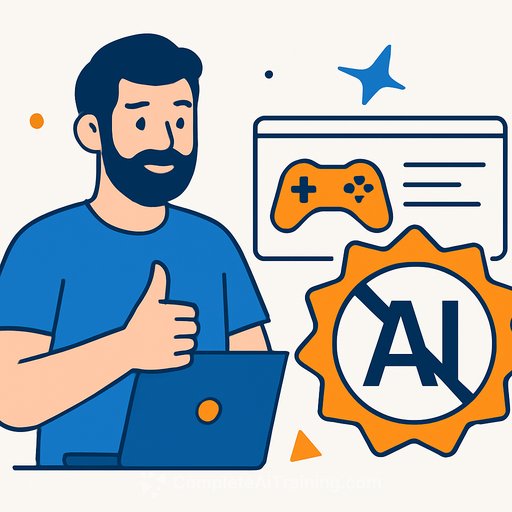
After Junghun Lee of Nexon claimed AI is everywhere, indie teams pushed against the narrative. Alex Kanaris-Sotiriou of Polygon Treehouse called it out and helped circulate a gold, cog-shaped seal stating, "This developer assures that no gen AI was used in this indie game." You'll see it on store pages for Rosewater, Astral Ascent, Quarterstaff, and others.
D-Cell Games took a bolder route with Unbeatable: "Absolutely everything... was created by human beings without any generative assistance," down to the frames, words, models, and songs. Producer Jeffrey Chiao added that beyond the debate, using gen AI would be a "huge waste of effort" for their quality bar.
Meanwhile, larger publishers continue to integrate AI into tools and content. Ubisoft has talked openly about Ghostwriter, which drafts incidental dialogue called barks. Teams across the industry are experimenting, from EA's partnerships to Microsoft initiatives, and gen AI assets have surfaced in titles like Call of Duty: Black Ops 6 and 7, Anno 117: Pax Romana, The Alters, The Finals, Arc Raiders, InZoi, and more.
The subtext: budgets are up, timelines are long, and AI promises speed. Yet the strongest resistance is coming from small teams who would seem to benefit the most.
Why sales should care
This is a live case study in differentiation. When a market tilts toward automation, "made by humans" becomes a premium. It reframes the buying decision from cost and speed to taste and trust.
Indie studios are doing three smart things sales teams can borrow:
- Counter-positioning: Define yourself against the default. If competitors lean into AI, you lean into craft and authorship.
- Proof, not promises: A visible seal, policy page, or process video beats vague ethics statements.
- Story over specs: Share trade-offs (like swapping to watercolors late in production) to show judgment, not shortcuts.
Turn their playbook into your sales motion
- Create a trust badge: Build a "Human-made" or "No gen AI" badge with a short, verifiable policy. Place it on your site, product, and proposals.
- Publish a disclosure page: List where you do and don't use automation. Be specific. Don't oversell.
- Script the contrast: "Competitors optimize for speed. We optimize for voice, quality, and accountability. Here's how that shows up in your outcome."
- Qualify with values: Ask, "Is human authorship important to your brand or compliance needs?" Let values help close - or qualify out fast.
- Show your process: Short behind-the-scenes clips, drafts, or before/after walkthroughs. Make the invisible craft visible.
- Price with integrity: If you charge more than AI-heavy options, tie the delta to risk reduction, originality, and brand safety.
Messaging you can steal
- One-liner: "Made by people, on purpose - for brands that care how their work is made, not just that it gets made."
- Website badge copy: "No generative AI used in creation or delivery. Reviewed by [team/role]. Auditable on request."
- Discovery question: "How important is human authorship for your legal, brand, or customer expectations?"
- Objection turn: "If pure speed is the goal, we may not fit. If you need distinct voice and lower IP risk, that's where we excel."
Signals buyers respond to
- Clarity: A simple, visible policy beats long statements.
- Consistency: Badge + policy + talk track + artifacts that match.
- Community proof: Public commitment that your audience can rally around.
Metrics to track
- Lead source mentioning "human-made" or "no AI"
- Win rate vs. AI-heavy competitors
- Sales cycle length on values-aligned accounts
- Average selling price when buyers cite brand safety or originality
Risks and how to handle them
- Hypocrisy risk: If you do use AI somewhere, disclose it clearly and explain why.
- Cost pressure: Use case studies that tie human craft to outcomes customers feel: retention, engagement, shareability.
- Credibility: Offer audits or artifact trails that validate your claim.
Names and moves to watch
- Indie stance: Polygon Treehouse's seal; D-Cell Games' human-only pledge for Unbeatable
- Enterprise adoption: Ubisoft's Ghostwriter tool for barks (official overview)
- Reported AI use in titles: Call of Duty: Black Ops 6 and 7, Anno 117: Pax Romana, The Alters, The Finals, Arc Raiders, InZoi
Bottom line for sales
Markets swing toward efficiency. That opens space to sell discernment. If your buyers care about voice, IP safety, and authenticity, plant your flag and make it easy to verify.
And if your buyers prefer automation, speak that language fluently so you can qualify fast and propose the right mix. If you want to upskill on the AI side to have those conversations, explore training by role (here).
Your membership also unlocks: