IRS Rolls Out Salesforce Agentforce As Staffing Cuts Hit Service Quality
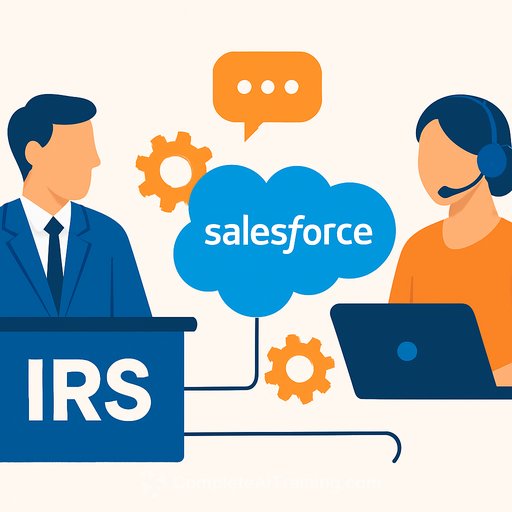
The IRS is deploying Salesforce's Agentforce across key divisions to keep service moving despite deep staffing cuts. Agentforce will support the Office of Chief Counsel, Taxpayer Advocate Services, and the Office of Appeals, with AI agents assisting staff on case prep and knowledge retrieval.
The goal isn't replacement. It's speed, consistency, and less swivel-chair work so agents can focus on taxpayer conversations and judgment calls.
Why This Matters For Support Leaders
The IRS shed roughly 25% of its workforce this year, falling from about 103,000 employees to 77,000, according to the Treasury Inspector General for Tax Administration (TIGTA). Funding has also been reduced, with long-term budgets tightened and proposed 2026 funding down around 20%.
That pressure shows up in contact center metrics. TIGTA reported nearly 250 taxpayer complaints during the 2024 filing season and flagged gaps: 11% of calls had poor service elements (unprofessional behavior, long holds, noisy environments) and 15% were dropped or disconnected. Courteous agents can still be hamstrung by volume and tools.
What Agentforce Will Actually Do
Salesforce secured FedRAMP High Authorization for Agentforce, Data Cloud, Marketing Cloud, and Tableau Next in June, and launched Agentforce for Public Sector in August. The IRS plan centers on AI agents for internal assist: generating case summaries, searching policy and historical data, and drafting communications.
This is the practical playbook for understaffed teams: compress research time, reduce repetitive tasks, and shorten handle time without removing human oversight.
Guardrails First, Automation Second
AI will not be making final decisions or disbursing funds. The focus is support work where a human can review and step in. That aligns with TIGTA's stance: the IRS still needs experienced people to interpret law, investigate crime, stop fraud, and execute complex system updates.
For any public sector contact center, the risk is clear-wrong guidance or hallucinated calculations can harm citizens. Ground every response in verified data, log reasoning, and make escalation easy.
A Broader Pattern In Government Contact Centers
Many agencies face the same math: more demand, fewer people. UK's HMRC tried to scale back helplines to push users into digital flows but reversed almost immediately after public and political pushback. In Canada, the CRA faced scrutiny over long waits and inaccurate answers; leaders are evaluating AI to support agents, not replace them.
As one industry voice put it, you can't squeeze 110% from people forever. If hiring isn't feasible, service models must evolve. Thoughtful AI assistance is one lever that can work in production-if you respect its limits.
Practical Playbook: How To Deploy AI Agents Without Breaking Trust
- Start with non-critical, high-volume tasks: case summaries, policy retrieval, email drafts, and disposition notes.
- Ground every response in approved sources: knowledge articles, policy manuals, prior case notes, and published FAQs.
- Keep a human in the loop for any advice that affects money, eligibility, compliance, or legal interpretation.
- Instrument everything: capture prompts, sources, versions, and outcomes for audit and coaching.
- Define escalation rules: when confidence is low, hand off to a human immediately with the AI's context attached.
- Set channel expectations: don't force callers into bots. Offer opt-outs and clear handoffs to live agents.
- Measure the right outcomes: average handle time, first contact resolution, recontact rate, time-to-knowledge, and customer sentiment.
- Train agents on AI prompts and review skills: the tool helps, but the human makes the call.
- Run staged rollouts: pilot with one queue, A/B test, document wins, then scale.
- Protect data: apply least-privilege access, redact sensitive fields, and align with compliance requirements like FedRAMP.
Quick Wins You Can Ship In 30-60 Days
- Auto-summarize long case histories so the next agent gets up to speed in seconds.
- One-click policy lookups pinned to call scripts and standard responses.
- Draft-and-review templates for emails, letters, and SMS with source citations.
- Real-time "next best action" checklists for complex processes to reduce errors.
What To Watch
- Model drift and content freshness: schedule regular knowledge updates and revalidation.
- Hallucination risk: block free-form answers in sensitive workflows; require citations.
- Agent trust: if the AI is wrong often, usage will tank. Track acceptance rates and fix fast.
- Citizen experience: monitor drop rates, hold time, and post-contact surveys during each rollout phase.
Why This Approach Works
Contact centers hit a real ceiling on productivity. When budgets and headcount shrink, the only scalable lever is removing the grunt work between the problem and the answer. Even small improvements-faster summaries, instant policy retrieval, cleaner drafts-compound across millions of interactions.
That's the IRS bet: keep humans for judgment, use AI to make every minute count.
Resources
- FedRAMP Program Overview
- Treasury Inspector General for Tax Administration (TIGTA)
- AI upskilling paths for support teams (Complete AI Training)
Bottom Line
If you lead a support team, treat AI agents like a force multiplier, not a replacement plan. Start small, ground everything in real data, and keep humans in control where it counts. That's how you improve service quality under pressure without risking trust.
Your membership also unlocks: