
AI news ·
Israel's Amal network trains teachers to use AI for personalized, democratic education
Israel's Amal Educational Network has introduced AI-assisted learning across 50 schools and 30,000 students. Teachers use it to personalize instruction and handle routine tasks, freeing time for mentorship and critical thinking.
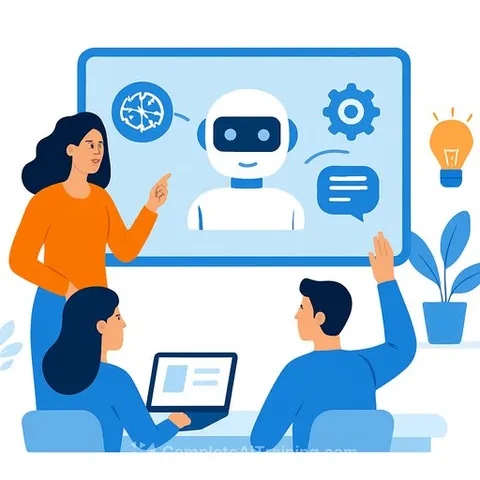
Israeli schools use AI to personalize learning while preserving teacher roles
Israel's Amal Educational Network is training teachers to use artificial intelligence in ways that deepen instruction rather than replace it. The initiative, called Pedagogical AI (PAI), operates across 50 schools serving 30,000 students and emphasizes personalization, independent learning, and ethics.
The approach emerged from a practical classroom moment. When Meirav Seror, vice principal at Amal Ramot high school in Beersheba, asked her literature students how they might use AI to study for exams, they immediately began experimenting. One student prompted an AI tool to turn key concepts into a rhyming song. The class learned the material faster than traditional methods allowed.
"We used to think our job was to be the source of knowledge," Seror said. "But today, knowledge is everywhere. Our role now is to be mentors, to guide, to question, to help students reflect and apply."
How AI shifts classroom tasks
The PAI program rests on five core principles: personalization, independent learning, collaborative learning, applied learning, and values-based education. Teachers across multiple subjects participate in a three-year professional development program.
In practice, AI handles routine work. One teacher uses AI to generate personalized reading exercises with audio support for struggling readers, turning a public struggle into private, supported learning. Math teachers create problem sets at different difficulty levels so each student progresses at their own pace.
"If you can give every student a personalized pathway, you are giving equal opportunity," Seror said. "That is a foundation of a democratic society."
These changes free teachers from worksheet creation and assessment prep. Dr. Dovi Weiss, Amal's head of techno-pedagogical innovation, frames the shift clearly: "Technology is not here to replace the teacher, but to extend the teacher. When AI takes over some of the repetitive tasks, teachers can spend more time on what matters most: relationships, values and deep learning."
Real-world projects and ethics
Amal students use AI tools to identify community problems and design solutions. Projects have included a smart suitcase for travelers with disabilities and small hydroelectric turbines for clean energy. Students used AI to enhance research and design, not to skip learning steps.
Ethics instruction is built into the program from the start. Teachers guide discussions on privacy, bias, and misinformation. Lessons teach critical thinking-comparing AI-generated content with other sources, examining algorithm bias, and evaluating social media claims.
Dr. Mor Tal, Amal's head of technological education and PAI director, said the network sees no contradiction between embracing AI and teaching its risks. "AI is not going away, and we don't want it to," Tal said. "The question is how we can harness it so that teachers gain time for real pedagogy, for caring about each student as a person."
Broader context and scale
Amal operates as a public system serving diverse communities across Israel-including immigrants, Arabs, Bedouins, haredim, and Druze. The network's focus on bridging social and economic gaps shapes how it approaches AI implementation.
Nearly all teachers in the network are already engaged in PAI. Amal is now working to expand the program's reach and develop tools that other schools can adopt. The network emphasizes that this model could apply beyond Israel, where education systems worldwide face similar questions about AI's role in classrooms.
For Seror, the shift has been personal. "After 30 years as a teacher, I feel like I am learning again," she said. "It gives me energy, and it gives my students hope."
For educators interested in how schools are integrating AI into daily practice, AI for Education resources provide frameworks and case studies. Teachers looking to develop specific skills can explore the AI Learning Path for Teachers, which covers pedagogical approaches similar to those Amal is implementing.