HR + IT: The partnership that makes AI agents work
AI agents are getting a lot of hype. The reality: most companies are still testing. In recent research from Wharton and GBK Collective, 58% of enterprise IT leaders say they're piloting agents, mostly for process automation, workflows, and customer service. Pilots - not production.
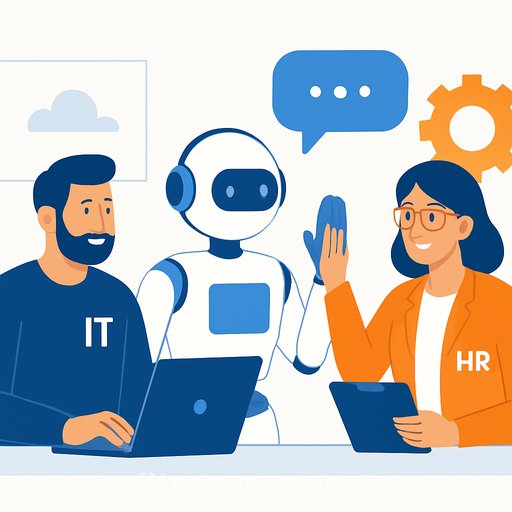
There isn't a ready-made playbook for human-AI workflows yet. That's exactly why HR and IT need to move in lockstep to reduce disruption, reskill people, and redesign team structures before agents scale.
Bring agents into the fold without burning out your people
Responsible rollout is a change-management project first, a tech project second. Sophos CIO Tony Young says the key is partnering with HR to bring the workforce along. That means new roles (automation experts, content curators, data stewards) and clear onboarding for both humans and agents.
At Sophos, marketing adds AI agents to org charts. New agents even get team-member announcements. IT runs a service desk leaderboard where humans can see how they compare to digital coworkers. Humans stay in the loop to validate agent work - and to keep trust high.
Baseline skills every employee needs
Young's view: learning to use an LLM or build a simple agent should be as common as learning Excel. HR and IT should co-own the training agenda: short courses, certifications, and hands-on practice tied to real workflows. No theory without application.
What an agent-infused org actually looks like
Think fleets of specialized bots collaborating to execute end-to-end processes. A "boss" agent coordinates work while human leaders set intent and guardrails. IT designs decision trees and workflow handoffs; HR helps teams adapt roles and incentives.
Different functions, different playbooks
- Call centers: Train associates to supervise agents, interpret intent, and set boundaries - a mix of soft skills and technical oversight. McKinsey's Klemens Hjartar calls this a new skillset that goes beyond today's toolbox.
- Sales and marketing: Redefine how agents interact with CRM and engagement systems. Expect changes to lead routing, campaign ops, and content QA.
- Operations: Map where agents update records, trigger orders, or escalate exceptions - then add checkpoints and audit trails.
HR's role: consistent messaging, role clarity, and reskilling paths. Some companies will add new positions like chief resource officer (to balance human and digital workers) or "agent bosses." McKinsey anticipates roles such as AI ethics and responsible-use leads, AI QA leads, and agent coaches.
Governance: give agents the right amount of autonomy
Amit Kinha, field CTO at DoiT, warns that giving agents too much decision authority introduces risk. Humans can tap tribal knowledge; agents can't - unless you design for it. "Where is the source of truth coming from?" he asks. If it's off, your entire decision tree is off.
Multi-agent systems that can update 15 systems at once can move metrics - and break things. Use permission tiers: some agents act, others propose and wait for approval. Too little autonomy and you stall. Too much and mistakes get expensive.
Practical guardrails
- Define intents and outcomes up front (what "good" looks like).
- Set data hygiene standards and a clear source of truth.
- Create approval tiers and human-in-the-loop checkpoints.
- Log every agent action; enable rollbacks.
- Run red-team tests before production access.
A 90-day HR playbook to get ready
- Week 1-2: Inventory roles and processes that touch agent pilots. Flag high-risk updates (customer data, finance, compliance).
- Week 3-4: Define roles and responsibilities (who sets intent, who supervises, who approves). Draft an RACI that includes agents.
- Week 5-6: Launch baseline training: LLM literacy, prompt quality, agent supervision, and data privacy. Add short assessments.
- Week 7-8: Pilot human-in-the-loop workflows with metrics (accuracy, cycle time, escalation rate, customer sentiment).
- Week 9-10: Stand up governance: access tiers, audit logs, rollback plans, and incident response for agent errors.
- Week 11-12: Review results, adjust autonomy levels, and plan phase two (more scope or tighter guardrails).
New roles HR should plan for
- Agent operations lead ("agent boss"): Owns agent performance, routing, and escalations.
- Chief resource officer: Balances human and digital capacity across teams.
- AI ethics and responsible-use lead: Policy, bias checks, and compliance.
- AI QA lead: Tests prompts, workflows, and edge cases before go-live.
- Agent coach: Trains teams on supervision, boundary-setting, and exception handling.
- Data steward: Maintains sources of truth and access policies.
Metrics that matter
- Quality: Accuracy, rework rate, false escalations.
- Speed: Cycle time, time-to-resolution.
- Safety: Policy violations, security incidents, rollback frequency.
- People: Employee sentiment, adoption rate, supervisor load.
- Customer: CSAT, NPS, repeat contact rate.
Training that sticks
Focus on applied skills: prompt quality, agent oversight, writing guardrails, and spotting failure modes. Blend microlearning with live labs on real processes. Tie certification to permission levels (read-only, propose, approve, execute).
If you're building a structured path, see courses and certifications by job function and vendor ecosystems here: AI courses by job and popular AI certifications.
What's next
Every company will move at a different pace. Some will automate aggressively; others will wait. The constant: HR and IT will sit at the center of how teams work, how decisions get made, and how outcomes get measured as agents scale.
Set intent. Set boundaries. Measure relentlessly. That's the work.
Sources and further reading
Your membership also unlocks: