Meet Jean-Zay, the Supercomputer Driving France’s AI Research
France holds the fifth position worldwide in the number of supercomputers—machines capable of performing millions or even billions of calculations per second. These high-performance systems are essential for advancing artificial intelligence (AI). Among them, Jean-Zay stands out as a powerful resource dedicated to academic research.
A Look Inside Jean-Zay
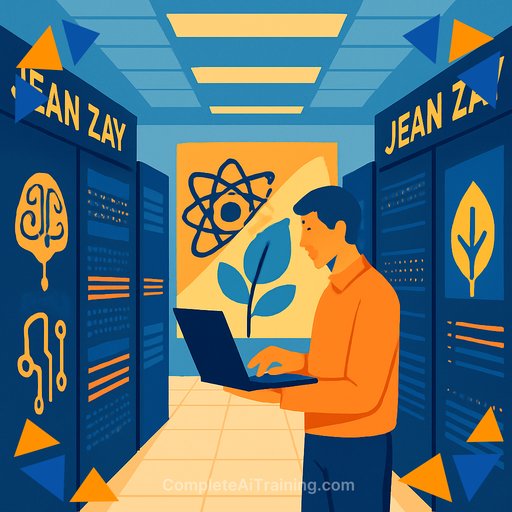
Located in a modest, white-walled room at the Paris-Saclay university in Orsay, just south of Paris, Jean-Zay occupies about the size of a tennis court. The room houses rows of server racks, each packed with 26 motherboards linked by turquoise cables. At peak performance, Jean-Zay can achieve 126 petaflops—equivalent to 126 million billion calculations every second.
The Role of Jean-Zay in Scientific Research
Despite popular imagination of supercomputers as autonomous entities, their true value lies in how researchers use them. Pierre-François Lavallé, director of IDRIS (the French National Centre for Scientific Research's high-level computing institute), explains that mastering the use of such machines is crucial. IDRIS manages Jean-Zay along with two other national supercomputers in France.
Jean-Zay supports around 1,000 scientific projects simultaneously, covering diverse fields such as medicine, climate science, road safety, and energy material research. Initially, the system was mostly used for simulations, including climate evolution and Covid-related studies. Today, 60% of projects focus on AI, reflecting a shift in research priorities.
Balancing Capacity and Energy Use
France is expanding its investment in computing power to strengthen its position in AI development. However, demand for access exceeds the system's capacity. Scientific committees allocate usage time, allowing selected researchers to use Jean-Zay free of charge, provided their findings and data are published openly.
As Jean-Zay’s processing power has increased, so has its energy consumption—but not proportionally. Since 2008, its computing speed has improved by a factor of 1,000, while electricity use has only increased eightfold. This efficiency gain is partly due to using GPUs (graphics processing units) instead of traditional CPUs. GPUs consume less energy per calculation, even though the overall system still demands significant power.
Cooling System and Heat Recovery
Running billions of calculations generates considerable heat, which must be managed carefully to avoid hardware failure. Jean-Zay employs a water-cooling system with copper pipes running through it, transferring heat away from the processors.
Raphael Medeiros, who oversees the technical infrastructure, highlights a heat exchanger that captures this "waste heat" and redirects it to the campus heating system. Water enters the supercomputer at about 30°C and exits at 36°C, carrying heat used to warm nearby buildings during winter. Approximately 6,500 megawatt-hours of heat are recovered annually, enough to heat 1,500 homes.
In summer, the heat is released outside through evaporation, with additional cooling measures deployed during very hot days.
Carbon Footprint Considerations
Jean-Zay operates on the French electric grid, which is largely powered by nuclear energy—a low-carbon source. This provides a significant environmental advantage compared to countries relying more heavily on fossil fuels.
However, the system’s primary goal remains computing performance. Keeping the supercomputer running continuously for scientific research is the top priority rather than maximizing heat recovery or reducing energy use.
Conclusion
Jean-Zay exemplifies how national supercomputing resources can facilitate cutting-edge AI research and scientific discovery. Its efficient design, strategic management, and integration with renewable energy sources position France as a key player in AI development.
For those interested in expanding their AI knowledge and skills, exploring targeted educational resources can be valuable. Check out Complete AI Training’s latest AI courses to stay current with practical AI capabilities.
Your membership also unlocks: