
AI news ·
Jim Cramer says companies must prove artificial intelligence is paying off
Jim Cramer demands proof of AI returns as corporate investments near $1 trillion. He warns that without concrete savings, skepticism will rattle the tech sector.
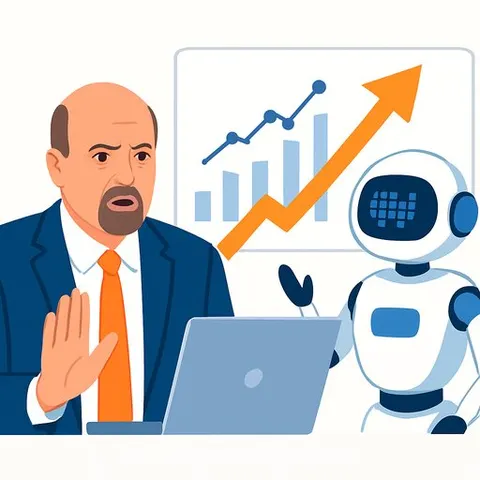
Jim Cramer is demanding that corporate America show hard numbers to back up its massive artificial intelligence investments. The "Mad Money" host said Wednesday that without concrete evidence of revenue gains or cost savings, skepticism about AI's business value will only intensify - and that could rattle the technology sector's biggest spenders.
"I need cold hard return facts," Cramer said. "Or, I, too, will grow more skeptical than I am now."
The AI boom has pushed technology companies to pour unprecedented sums into infrastructure, with analysts projecting total AI capital expenditures could surpass $1 trillion by 2027. Cramer said he remains optimistic about the long-term opportunity, but argued that the current earnings season has produced little proof that those investments are generating measurable financial returns for the companies buying the technology.
The trillion-dollar question
"We're still early in the earnings season but already we are not hearing anything material about the use of AI," Cramer said. While component makers like memory-chip manufacturer Micron are thriving, the same cannot be said for the end users. Cramer pointed to the disconnect between the billions flowing into AI infrastructure and the silence from corporate clients about actual savings or efficiency improvements.
"Sure Anthropic is getting a return ... The component companies are doing well," he said. "But shouldn't the ultimate clients ... be able to cite at least a couple of million in savings?"
Banks miss the mark
Financial institutions have been a particular disappointment. Cramer said banks looked like natural beneficiaries of AI, given the potential to automate back-office processes and improve efficiency ratios. Yet management teams have offered little evidence that the technology is moving the needle. For professionals focused on AI for Finance, the gap between promise and performance is becoming harder to ignore.
"It's valuable, but nothing that can raise numbers," Cramer said. "It's not helping the efficiency ratio that we can tell and it's not allowing them to cut back on hiring. Does that mean AI is a bust? No. But I don't see it making much difference."
A few bright spots, but skepticism lingers
Only a handful of companies have directly tied recent layoffs to AI adoption, including fintech firm Block and web-security provider Cloudflare. Block disclosed AI-related job cuts in February, and Cloudflare's reductions came in May. Critics have also warned of AI washing - the practice of invoking AI as a trendy excuse for layoffs that might have happened anyway.
For AI for Executives & Strategy, the lack of tangible returns presents a real risk. Cramer said that if businesses do not start reporting clear results soon, the skeptics will grow louder, and the market's trust in tech's big spenders will erode. "The longer we go without hearing how actual clients make money," he said, "the longer we'll take days like today, when it seems that the hyperscalers are making money," with a grain of salt.
Why this matters for finance professionals
The earnings silence around AI returns is a red flag for anyone allocating capital or evaluating tech investments. When banks and other large enterprises can't point to even a few million dollars in savings from AI, the case for continued spending at current levels weakens. Finance leaders need to watch whether this gap widens - because it could signal a pullback in AI investment that hits the entire tech supply chain.