
AI news ·
JPMorgan and Anthropic push AI from advisor to autonomous operator in financial services
JPMorgan will deploy autonomous AI agents in 2026 with account-level guardrails, not model-level discretion. Task-specific AI agents are projected to jump from under 5% of enterprise applications in 2025 to 40% by end of 2026, per Gartner.
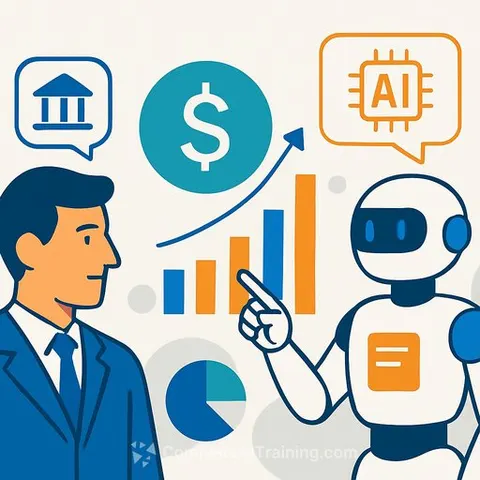
JPMorgan plans to deploy autonomous AI agents in 2026, with guardrails set at the account level rather than left to the model's discretion. The move reflects a broader operational shift documented in new Gartner data: task-specific AI agents are projected to appear in 40% of enterprise applications by the end of 2026, up from under 5% in 2025. For operations leaders, this signals a transition from AI that advises to AI that executes, managing workflows, initiating payments, and interacting with financial infrastructure without waiting for human approval at each step.
Most AI in use today is advisory. It summarizes, drafts, and recommends, then waits. Agentic AI inverts that sequence. A system receives a goal and the authority to pursue it, calling APIs, deploying software, or moving funds within parameters set by humans. Michael Heinrich, CEO of 0G Labs, told TheStreet the sectors likely to change first share a common trait: "The first domains to flip are the ones that are already digital and rule-bound: payments and treasury, software development, and digital asset operations." If a process already runs through software, an AI agent can be inserted without rebuilding from scratch.
Why finance is moving first
Financial systems have grown increasingly programmable over the past decade. Payments move through APIs, assets exist digitally, and transactions settle via automated contracts. The IMF noted in April 2026 that agentic AI systems capable of initiating and managing financial operations under delegated authority have begun emerging across payments and financial markets. The infrastructure that once required a human operator at every step is now machine-readable.
Anthropic reinforced this momentum in May 2026 by releasing 10 AI agents built for financial services, targeting tasks from investment banking pitch decks to compliance review. Eric Swartz, founding general partner and general counsel of Panther Hollow Ventures, said the change runs deeper than automation. "The biggest shift may not be automation, but participation," he told TheStreet. An agent authorized to manage treasury operations can monitor liquidity, rebalance allocations, and initiate payments when conditions trigger, all without a human approving each action. The human designs the envelope. The agent operates inside it.
The trust and verification gap
Capability is not the bottleneck. Accountability is. Financial systems rest on human identity, liability, and legal recourse. When an autonomous agent transacts, borrows, or holds assets, existing frameworks offer no clean answer for who is responsible when something breaks. Swartz said the core issue is straightforward: "The key challenge is trust. Financial systems are built around human identity, liability, and accountability." He added a timing warning: "The technology may arrive before the market structure."
This is not a theoretical concern. The question of what an agent is permitted to do is separate from whether you can verify what it actually did. Heinrich put it bluntly: "Privacy, transparency, verifiability, and safety are not nice-to-haves for autonomous systems, they are the precondition for trusting one with a transaction." The audit infrastructure must match the agents themselves before pilots graduate to real financial activity. Fortunately, a clear pattern is emerging in serious implementations: bounded operating environments with defined roles, permitted actions, spending limits, and full audit trails. JPMorgan's approach, building guardrails at the account level, reflects this design philosophy.
Where operations teams can act now
McKinsey's 2025 global survey found that 62% of organizations are experimenting with AI agents, but only 23% are actively scaling them, and most only within one or two functions. The gap between capability and deployment suggests a practical opening. Workflows that already run through software and rule-based systems, such as internal treasury operations, software pipelines, and data management tasks, do not require new legal frameworks to begin. They are structurally ready for autonomous participation in ways that physical operations are not.
Casper Network CTO Michael Steuer reinforced the principle guiding these early implementations: "The value will not come from giving an AI unconstrained custody of capital." The humans set the boundaries. The agent executes within them. This is the operational model that companies are quietly adopting, and it requires a different skill set from managing traditional automation. Operations professionals who understand how to define those boundaries, specify permitted actions, and verify execution will be the ones leading the deployment. Those who treat agentic AI as just another software tool may find the technology moving faster than their frameworks can handle. For structured training on these shifts, an AI Learning Path for Operations Managers can help bridge the gap. Courses tagged under AI for Operations also address the specific challenge of transitioning teams from overseeing human workflows to designing and monitoring autonomous agent activity.
Why this matters for operations leaders
Agentic AI changes the operations role from managing human workflows to designing the parameters within which autonomous systems operate. The immediate opportunity sits in digital, rule-bound processes like treasury, payments, and software pipelines, where the infrastructure is ready and the legal friction is lowest. The preparation task is specific: learn to define bounded operating environments with clear permissions, spending limits, and verifiable audit trails. The technology is arriving. The operational frameworks that make it safe and auditable are what will determine how fast it actually scales.