
AI news ·
Kaiser Permanente nurses say workplace surveillance and artificial intelligence threaten patient care
Kaiser Permanente uses AI to enforce 15-minute call limits, risking patient safety. The union is now negotiating contract protections for 25,000 nurses.
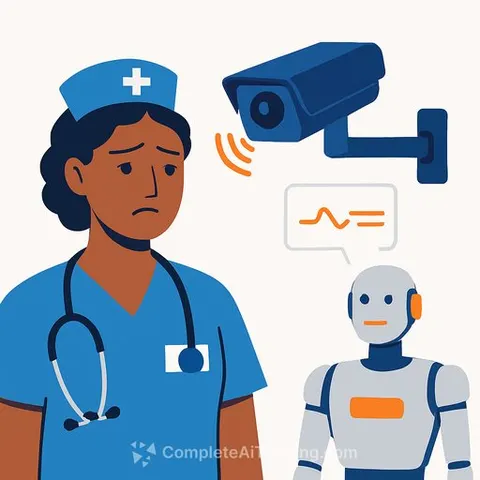
Kaiser Permanente advice and triage nurses say workplace surveillance that tracks call length, uses AI to predict productivity, and even rates empathy and tone of voice is threatening their duty of care. Seven current and former nurses told CalMatters that spending more than 15 minutes on a patient call routinely triggers criticism from management or performance evaluation meetings. Kaiser is the largest private employer in California, serving more than 9 million people, and its use of AI could set important precedents for how healthcare workers are managed and how patient care is balanced against cost-cutting automation.
Nurses described a system where call time feeds into monthly performance scores. Raquel Alvarez Sanchez, an advice nurse in Vallejo since 2010, said she stayed on a call with a suicidal patient for over an hour while waiting for police to arrive. She knew that would throw off her average call time for weeks. "I think at some point all of the nurses have been talked to about their average handle time," Sanchez said. "The only thing I can think of is they're doing it for profit."
Another nurse, speaking anonymously for fear of retaliation, described withholding compassion from an elderly woman who had just received a terminal cancer diagnosis because she feared a longer call would hurt her performance score and lead to a reprimand. "I had to ask myself: Am I going to get disciplined for going off script or saying more than what is necessary?" she said.
Kaiser's response and the AI empathy tool
Kaiser Permanente said it does not use "average handle time" to assess performance and that any tools used in contact centers support quality assurance with human review and oversight. Spokesperson Vincent Staupe said the company uses AI responsibly, "prioritizing patient safety, privacy, and equity," but declined to share details about internal technology systems for security and operational reasons.
In summer 2024, Kaiser began testing an AI tool that attempts to assess empathy and tone in the voices of nurses and patients. Nurses circulated a petition with the tag line "Trust nurses, not AI." The tests ended in November 2024, but union representatives were told the program could return. One nurse said "AI did not understand our job and would grade us wrong all the time."
Pressure on call times and patient safety
Nurses said they are pressured to keep calls under 15 minutes even for complex cases involving multiple symptoms, chronic illness, new parents, or patients needing interpreters. Calls with interpreters often take 30 minutes or more. Nurses also said they now get as little as 30 seconds between calls during busy periods, down from about 10 minutes in the past. "The amount of time that Kaiser is giving us to complete a call is sometimes not safe," one nurse said.
Charlotte Capulong, a nurse with 22 years in call centers, said she has seen managers discipline nurses solely for call length, even when all other duties were performed correctly. "You aren't calling Comcast. We're dealing with life here," she said.
Consumer Watchdog patient advocate Michele Ramos said many patient complaints about Kaiser may originate with the constraints nurses face on the advice line. Kaiser was hit with a $50 million fine in a settlement over delayed behavioral health appointments, and Ramos sees the time pressures as part of a broader pattern of prioritizing cost over quality.
Surveillance, AI, and the future of nursing
The nurses' experiences reflect a broader trend of algorithmic management increasing stress for workers handling complex, emotionally charged issues. Virginia Doellgast, a Cornell University researcher who has studied call center surveillance for over a decade, said stress and burnout in healthcare settings carry higher risks because "you're dealing with people's lives and their health." A 2023 academic survey found that nearly half of call center workers said AI tools made their jobs more stressful.
Pa Vue, a nurse and union representative, has seen performance scores reduced for repeating advice to a patient she worried had heart issues. She said the push for efficiency can hinder a nurse's ability to focus. "I'm not against the use of AI as long as it's beneficial to the patient but in this particular use it's to increase productivity and improve efficiency and cut costs," Vue said. "Kaiser is forgetting we aren't just a call center for customer support, we're nurses, and we're there to take care of patients."
The California Nurses Association is negotiating a new contract for 25,000 nurses, including 1,000 in call centers, with AI as a key issue. State lawmakers are considering several bills to regulate AI in the workplace, including one that would protect doctors and nurses who override automated care recommendations from retaliation. The nurses' experiences highlight a growing tension in AI for Healthcare, where automated tools are increasingly used to monitor and evaluate clinical staff.
Why this matters for healthcare professionals
For nurses, physicians, and other clinicians, the Kaiser case shows how AI-driven surveillance can directly shape clinical interactions. When call length, script adherence, and even vocal tone are scored by algorithms, clinicians may feel forced to choose between following their professional judgment and protecting their employment. The pressure to stay under arbitrary time limits can discourage the very compassion and thoroughness that patients need, especially during moments of crisis. Healthcare professionals should watch how these tools are deployed in their own workplaces and advocate for transparency, human oversight, and the right to override automated recommendations without fear of discipline.