
AI news ·
Karnataka Budget Pushes AI Statewide: Farm Helplines, Classroom Tutors, New Research Hubs
Karnataka's budget puts AI into classrooms and labs: tutors for classes 8-12, 50 college labs, and research hubs at ART-PARK and IIIT Raichur. Teachers: pilot, train, protect data.
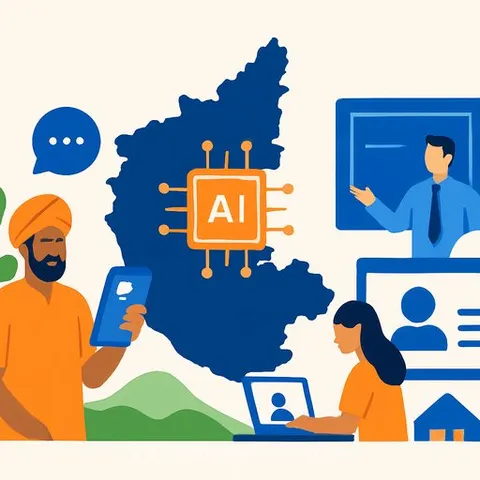
Karnataka budget presses the AI accelerator: what educators need to know
Karnataka is pushing AI deeper into classrooms, labs, and public services. The budget outlines new tools for students, labs for colleges beyond Bengaluru, and research hubs to keep the state ahead.
If you work in education, this is your signal to get practical. The initiatives below will touch your curriculum, teacher development, infrastructure, and how students learn day to day.
AI tutors for classes 8-12 (in collaboration with IIT Dharwad)
Schools will get AI-driven learning tools built with IIT Dharwad. The plan: a personalised self-learning digital tutor for nearly 12.3 lakh students across classes 8-12, funded at around Rs 5 crore.
Expect help with tricky mathematics, complex science concepts, and targeted practice. Think of it as a co-teacher: it gives explanations and feedback, while you guide, supervise, and set the standard for thinking and ethics.
AI data labs in 50 government colleges (Tier-2 and Tier-3 first)
The state will set up modern AI labs in about 50 government colleges, backed by Rs 10 crore under the Centre's AI Mission. This brings hands-on projects, datasets, and compute access closer to smaller cities and rural districts.
Use this to start capstone projects, peer-led workshops, and community problem-solving-local language tools, agri analytics, and service delivery prototypes included. Details on the national mission are available here: IndiaAI Mission.
Research and innovation: BRAINz at ART-PARK and a CoE at IIIT Raichur
The Bangalore Robotics and AI Innovation Zone (BRAINz) will come up at the AI and Robotics Technology Park (ART-PARK) under IISc, with ISRO and Keonics as partners. Expect stronger industry-academia pipelines, internships, and student projects that actually reach deployment.
Separately, a Centre of Excellence for AI at IIIT Raichur (Rs 5 crore) will focus on advanced research and tech development. This is your route for faculty collaborations, joint advisories, and research exposure for high-potential students.
What else is changing
- AI-based facial recognition attendance at anganwadis, schools, colleges, and hostels.
- Polytechnics and engineering colleges to introduce AI, machine learning, cloud computing, and automation engineering courses.
- AI-based paperless registration under Kaveri 3.0 to be developed for Rs 65 crore (less paperwork for administrators and families).
- The food and civil supplies helpline will be upgraded to "Smart Annavani".
- Bengaluru ranks 5th among the world's top 50 cities in AI and big data-use this momentum to secure partnerships and mentors.
Action plan for school and college leaders
- Infrastructure check: Count functional devices, bandwidth per classroom, and safe login systems. Plan for shared device rotations where needed.
- Pilot fast: Pick two subjects (e.g., math and science) and run a 6-8 week AI-tutor pilot with clear metrics.
- Upskill staff: Train teachers on prompt strategies, misconception spotting, and AI oversight. Pair early adopters with peers.
- Data and privacy: Set consent processes for students and parents. Clarify what data the tools collect and how long it's stored.
- Content alignment: Map AI tutor content to your syllabus and exam patterns. Flag gaps or errors and create a feedback loop.
- Equity plan: Provide offline or low-data modes and supervised lab hours for students without home access.
- Measure outcomes: Track attendance, concept mastery, and error rates on problem sets-not just "time spent".
For teachers of classes 8-12
Use the AI tutor for targeted practice, varied explanations, and step-by-step problem solving. Keep student thinking visible: ask for reasoning, not just answers, and rotate between individual and group work.
- Warm-ups: Quick 5-question sets that diagnose misconceptions before you teach.
- Guided practice: Students solve while the tutor explains; you circulate and correct strategy, not just steps.
- Concept repair: Create small "fix-it" modules for common errors you see in your class.
- Exam preparation: Past-paper style questions with timed modes and error review logs.
- Low-connectivity backup: Cache key lessons and problem sets for offline sessions in labs.
If you're getting started and want a structured path, see this AI Learning Path for Secondary School Teachers.
Questions to ask the department (before rollout)
- What's the device and bandwidth requirement per classroom? Any pooled device plans?
- Which languages and accessibility features are supported at launch?
- How does the AI handle student data, chat logs, and analytics? Who has access?
- How will AI tutors integrate with current LMS, DIKSHA resources, or assessment tools?
- What is the teacher training timeline, certification, and support channel?
- What are the success metrics and review cadence for schools and colleges?
What this means for rural and smaller institutions
The new labs and courses mean more students can learn AI skills without relocating. Start by building a student volunteer team, scheduling predictable lab hours, and partnering with nearby industries or government offices for real datasets.
Keep safety and ethics front and center: verify data sources, avoid unvetted facial recognition pilots with students, and ensure community consent for any field projects.
Bottom line
The state is moving AI from headline to classroom. If you lead a school or college, pick a pilot, train your staff, protect student data, and measure what matters. Small, well-run experiments now will compound into stronger outcomes by year-end.