
AI news ·
KAYTUS upgrades KSManage with four-level monitoring framework for AI data centers
KAYTUS upgraded KSManage to monitor AI data center infrastructure across four layers, from individual components to active jobs. The platform predicts hardware failures up to seven days out and identifies 90% of fault root causes within five minutes.
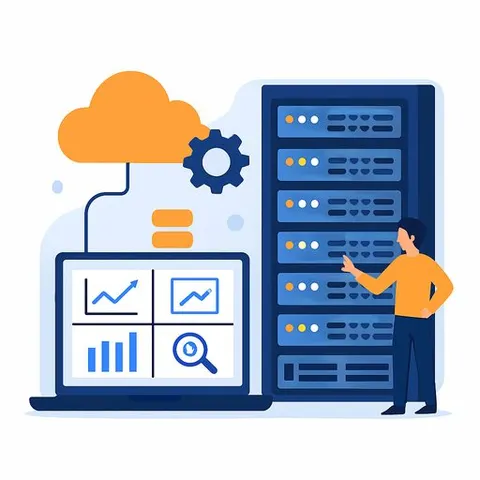
KAYTUS Upgrades Data Center Monitoring Platform to Handle AI Workload Complexity
KAYTUS has enhanced KSManage, its operations and maintenance platform, to provide visibility across four layers of AI data center infrastructure: individual components, servers and cabinets, clusters, and AI jobs. The upgrade addresses operational challenges that arise when data centers run complex AI workloads at scale.
A single outage in an AI data center can cost more than $1 million. Traditional monitoring systems treat infrastructure as isolated devices rather than interconnected systems, making it difficult to pinpoint failures quickly.
Four Operational Challenges in AI Data Centers
Infrastructure complexity slows troubleshooting. AI data centers combine heterogeneous CPUs, GPUs, and DPUs across computing, networking, and storage systems. When problems occur, traditional monitoring cannot track faults across the full system, extending recovery time and reducing availability.
Component failure rates are rising. GPU power consumption has increased more than fivefold over the past decade. Cabinet power density now reaches 20-50 kW and approaches 200 kW in some cases. Under sustained high-load conditions, core components fail more frequently, but traditional systems lack real-time health tracking and predictive analysis to catch early warning signs.
AI applications lack end-to-end monitoring. Workloads like large language model training, autonomous driving, and scientific computing impose diverse demands on compute, network, and storage. When hardware issues occur-such as GPU memory leaks or InfiniBand packet loss-traditional monitoring cannot correlate them to specific jobs. Industry data show that approximately 8% of unplanned LLM training interruptions stem from optical module or fiber failures. Even millisecond-level packet loss can force training restarts and rollbacks, wasting compute resources.
Manual processes delay responses. Cross-regional collaboration, resource scheduling, and network planning still rely heavily on manual work. Limited staffing forces operations teams into reactive rather than proactive fault management, extending mean time to repair.
KSManage's Four-Layer Visibility Framework
Full-stack visibility with real-time troubleshooting. KSManage collects GPU and CPU utilization, video memory usage, power consumption, network bandwidth, and storage health in real time. It aggregates operational events and network logs, then uses automated topology discovery to track end-to-end workloads across nodes. The platform correlates device health with port-level telemetry throughout a job's lifecycle and visualizes resource allocation through 3D modeling. This approach improves troubleshooting efficiency by up to 90% compared to traditional siloed monitoring.
Predictive hardware analysis with early warning. KSManage applies algorithms to analyze performance trends of GPUs and storage devices, identifying early signs of abnormal wear. The system can predict hardware failure risks up to seven days in advance. It monitors load and temperature continuously to prevent failures under sustained high-load conditions.
End-to-end application correlation. KSManage monitors critical network metrics including bandwidth, latency, and packet loss. The platform reserves a 20% bandwidth margin to ensure stable data transmission, maintaining millisecond-level internal latency and keeping packet loss below 0.01%. This enables the system to map hardware anomalies directly to specific training jobs, rapidly identifying root causes of LLM training interruptions.
Automated operations across four layers. The unified architecture enables end-to-end automated operations and fault diagnosis. Automated backup success rates reach nearly 99.8%. The platform uses knowledge graphs and time-series anomaly detection to automatically identify up to 90% of root causes within five minutes. Operations efficiency increases by up to four times, and total cost of ownership drops by up to 40%. Storage capacity risks can be predicted three days in advance.
Getting Started
KAYTUS offers a free trial of KSManage that launches in a few clicks. Interested users can visit the trial signup page or contact ksmanage@kaytus.com for more information.
Operations professionals managing AI infrastructure can explore AI for Operations resources to understand how these tools fit into broader operational strategies, or pursue an AI Learning Path for Operations Managers to develop skills in this area.