Kazakhstan sets May 2026 deadline for AI in water resources management
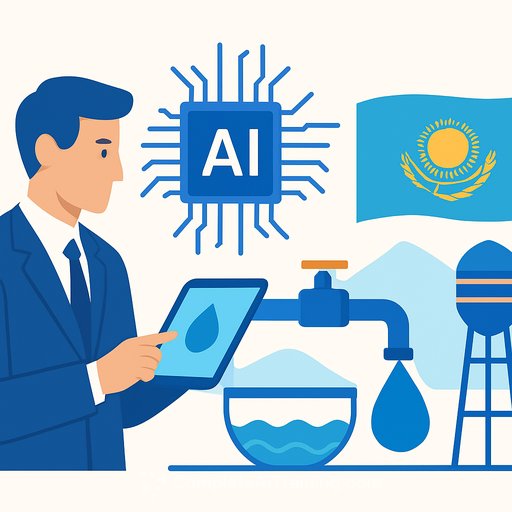
Kazakhstan is moving to apply AI in water management. Prime Minister Olzhas Bektenov has directed the Ministry of Water Resources and Irrigation to launch an AI-based project by May 1, 2026.
The announcement was made at a meeting with the National Academy of Sciences, leaders of government agencies, several regional governors, and business representatives. The project will be developed with the Ministry of Artificial Intelligence and Digital Development and the Ministry of Science and Higher Education.
Why this matters for management, science, and research
Water stress is a strategic risk across Central Asia. An AI-backed system can help forecast demand, optimize allocation, and flag risks earlier-especially when paired with existing infrastructure like the newly deployed Water Base information system from Kazhydrogeology.
For leaders, the signal is clear: data integration, cross-agency coordination, and applied research are now on a fixed clock. Expect procurement, data governance, and pilot deployments to move in parallel.
Key timelines and responsibilities
- By March 1, 2026: The Ministry of Science and Higher Education, with sectoral state agencies, will review the Academy of Sciences' proposals for a new model to set priorities in science and technology.
- By March 1, 2026: Sectoral state agencies will approve roadmaps to address technological and production challenges and to implement applied scientific developments.
- By April 1, 2026: Regional governors will set up and chair regional scientific and technological councils. Together with the National Academy of Sciences, they will approve scientific and technical assignments based on regional specialization and foresight studies.
- By April 1, 2026: The National Academy of Sciences will create a Center for Scientific and Technological Foresight and conduct the related research.
- By May 1, 2026: The Ministry of Water Resources and Irrigation will launch the AI project with the Ministry of Artificial Intelligence and Digital Development and the Ministry of Science and Higher Education.
What an effective AI water program could include
- Data backbone: Unified ingestion from hydrological sensors, satellites, SCADA, and the Water Base system; standardized metadata; API access for agencies and research teams.
- Modeling and forecasting: Basin-level inflow predictions, demand forecasting for agriculture and cities, anomaly detection for losses and leaks, scenario analysis under different climate and policy inputs.
- Decision support: Role-based dashboards for ministries, utilities, and regions with alerts, recommended actions, and audit trails tied to KPIs.
- Governance and security: Data-sharing agreements, model validation protocols, versioning, and clear accountability across institutions. See AI Research and Methodology for background on research practices, data governance, and model validation.
- Integration: Interoperability with existing regional systems and open standards for future expansion.
Practical next steps for leaders
- Map critical data sources and close gaps (sensors, telemetry, historical archives). Identify owners and access rules.
- Define priority use cases that deliver measurable outcomes within 6-12 months (e.g., irrigation scheduling, reservoir operations, non-revenue water).
- Stand up a cross-functional delivery team (policy, hydrology, data engineering, MLOps) with a single executive sponsor.
- Plan pilots by basin or region with clear baselines, KPIs, and a path to scale.
For context on global practices, see the World Bank's overview of water resources management and the OECD's work on water governance.
Skills and capability building
Teams rolling out data platforms and AI models will need upskilling in data engineering, geospatial analysis, and model operations. Curated options by role include the AI Learning Path for Production Planners and the AI Learning Path for Supply Chain Analysts.
Your membership also unlocks: