Korean Air's multilingual AI chatbot: what support leaders can learn
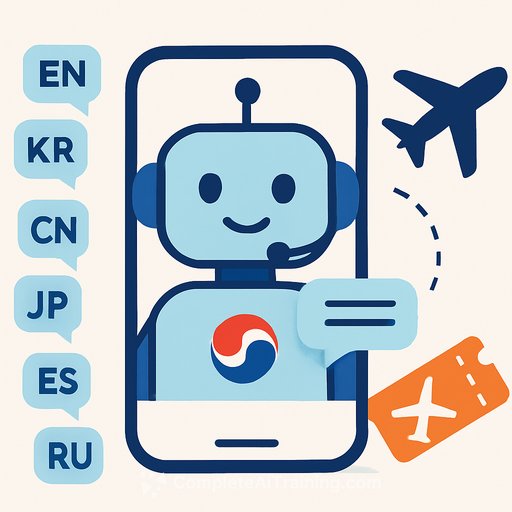
Korean Air has launched a new AI chatbot across its website and mobile app, supporting 13 languages including Korean, English, Japanese, French, Russian, and German. It analyzes customer questions in real time and delivers relevant answers, with plans to handle ticket purchases and reservation changes next.
This isn't their first step. An earlier bot, KALI, has handled more than 500,000 customers per month since 2020. The new rollout sits inside a larger plan: an AI-powered Contact Center built with Amazon Web Services, with machine learning and generative AI slated after a platform consolidation completes by February 2025. The airline is taking a hybrid approach - giving agents AI assistance instead of trying to replace them outright.
For customer support teams, this is a playbook: start with multilingual self-serve, modernize the contact center stack, then layer in transactional flows and agent-assist. You don't need a moonshot - just a focused roadmap and solid data foundations.
Why this matters for support operations
- Deflection without dead ends: Multilingual coverage reduces wait times and email backlog, but only if handoffs to humans are smooth. Build clear escalation paths and display them early.
- Agent-assist beats agent-replace: Use generative AI to summarize context, suggest responses, and surface policies. Keep humans in the loop for edge cases and empathy.
- Platform first, models second: Consolidate telephony, chat, email, and CRM before scaling AI. Fragmented tooling kills ROI and makes analytics unreliable.
- From FAQs to transactions: Start with high-volume intents (baggage, schedules, seat rules). Then add bookings, changes, and refunds once identity, fraud checks, and audit trails are in place.
- Measure what matters: Track containment rate, CSAT, AHT, agent handle ratio, and time-to-train-new-intents. Set guardrails for PII and policy compliance.
The wider shift: AI beyond chat
Airlines are moving past simple Q&A to operational decisions. American Airlines uses AI to reduce missed connections and rebook disrupted passengers. Lufthansa applies AI to speed up aircraft turnaround times, improving on-time performance and lowering costs. The takeaway: service quality is now tied to how well your AI links customer intent with live operations, not just how fast a bot replies.
One enabling piece is the rise of agent orchestrators - software that routes tasks across models and business systems. Instead of a single bot, you have a router that chooses the right tool for the job (NLP, payment service, reservation system), then logs the outcome for training and audit.
Practical build steps
- Consolidate the stack: Move to a unified contact center platform and CRM with stable APIs and conversation history. If relevant, explore AWS options like Amazon Connect.
- Prioritize languages by volume: Roll out tiers based on ticket volume and CSAT impact. Expand once you've validated intent accuracy per language.
- Design for escalation: Offer a visible "talk to a person" path. Avoid removing critical channels-Frontier's removal of phone support shows the risk to trust and resolution speed.
- Harden transactions: Before bookings or changes, set up authentication, fraud checks, and reversible workflows. Treat payments and refunds as high-risk flows with extra logging.
- Agent co-pilot first: Ship internal tools that summarize chats, propose replies, and fetch knowledge. Use feedback loops from agents to train and prune intents. Consider AI Design Courses to help teams craft effective agent-assist workflows and conversation experiences.
- Close the loop: Capture outcomes (solved, escalated, refund issued) to improve routing and forecasting. Tie metrics to staffing and scheduling.
What this signals
Korean Air's path - cloud first in 2021, chatbots at scale, then AI across the contact center - shows a steady, low-drama way to modernize support. If you're leading a support org, treat this as a sequence: unify systems, ship multilingual self-serve, empower agents, then automate transactions.
Want to upskill your team for this shift? See curated options for support roles here: AI courses by job.
Your membership also unlocks: