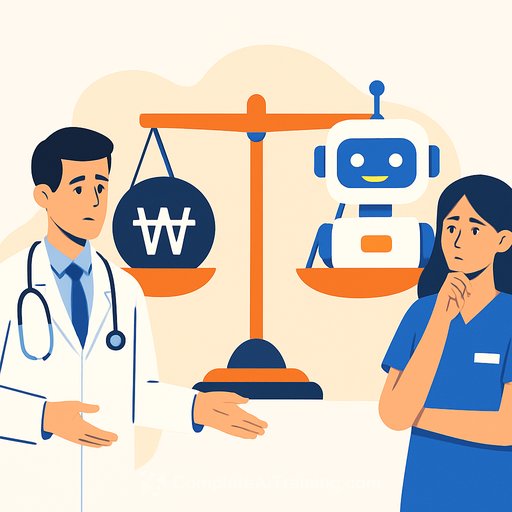
Healthcare Policy, Not AI Technology, Will Determine Workforce Changes
Experts disagreed on whether artificial intelligence will reshape Korea's healthcare workforce at a major industry forum this week, with some arguing that policy matters far more than technological capability.
Dr. Kim Han-su, president of Ewha Womans University Mokdong Hospital, said AI will not reduce the number of doctors in Korea. He attributed this to the country's fee-for-service reimbursement system, which creates different incentives than value-based healthcare models elsewhere.
"Korea's healthcare runs on a fee-for-service system. In the U.S., under value-based healthcare, efficient charting and billing matter, but not in Korea," Kim said at the "AI in Hospitals" forum during the 17th Korea Healthcare Congress on Thursday in Seoul.
Kim argued that efficiency gains from AI rarely translate into workforce reductions under this model. "Policy, not just AI, drives adoption," he said.
Professor Kim Hyun-cheol of Yonsei University College of Medicine offered a different perspective. He predicted AI's effects in medicine would emerge more slowly than in other industries, but said the technology should address structural problems rather than replace workers.
He pointed to Korea's "three-minute consultation" as a target for improvement. "AI can cut doctors' repetitive tasks and charting, allowing more time for patient care and better communication," he said.
A third expert offered a more dramatic forecast. Yoon Eul-sik, Vice President of the Korean Hospital Association and CEO of Korea University Medicine, predicted that full AI integration would shrink the medical workforce by roughly one-third through automation and workforce restructuring.
The disagreement reflects a broader question for HR professionals: whether workforce changes stem from what technology can do or from how organizations choose to use it. AI for Human Resources professionals managing healthcare staffing should understand both technological capabilities and the policy environment shaping adoption decisions.
HR leaders overseeing healthcare operations may find AI Learning Path for CHROs useful for developing workforce strategies that account for these competing factors.
Your membership also unlocks: