
AI news ·
Law firms face sanctions and governance gaps as AI hallucinations spread through legal filings
U.S. courts handed out over $145,000 in sanctions against law firms in early 2026 for filing AI-generated fake citations and fabricated legal theories. More than 300 federal judges now have standing orders on AI use in court filings.
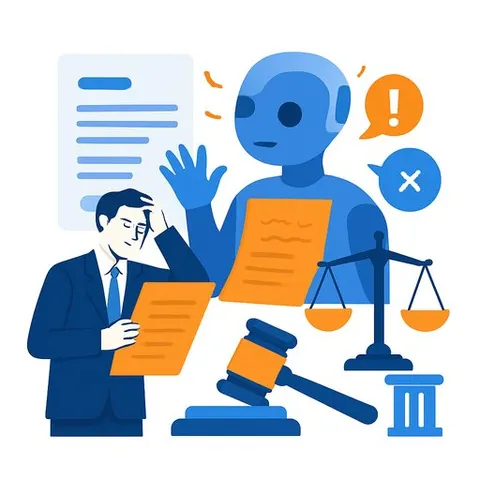
Law Firms Face Growing Sanctions Over AI-Generated Legal Hallucinations
U.S. courts imposed over $145,000 in sanctions against law firms in the first quarter of 2026 for submitting briefs containing fabricated legal reasoning and fake citations generated by artificial intelligence. More than 300 federal judges have adopted standing orders addressing AI use in filings, and the number of documented cases involving AI hallucinations continues to climb.
The problem extends beyond simple factual errors. Generative AI systems now produce convincing but entirely fictional legal theories-complete with invented case citations and arguments-that pass traditional verification checks. A hallucinated legal theory can clear cite-checking tools like Westlaw and Lexis, only to collapse under court scrutiny.
Cat Casey, legal tech expert and partner at Masters AI Legal, said legal theory hallucinations are the hardest to catch. "A hallucinated legal theory passes every cite check and still blows up your case," she said. A database tracking AI-related legal decisions has cataloged over 1,369 cases involving hallucinations, though that number represents only what courts detected.
Courts are not catching everything. "Courts don't routinely verify every citation. Fabricated authorities pass undetected constantly, especially in cases that settle or where opposing counsel lacks resources to check," Casey said.
Shadow AI Compounds the Risk
Beyond hallucinations, law firms face a second threat: employees using unapproved AI tools without authorization. Over 68% of legal professionals admitted to using unapproved AI tools at least once in the past year, yet fewer than 20% of firms have formal policies to manage the exposure.
Andrew Adams, partner and chief administrative officer at DarrowEverett, called shadow AI arguably more dangerous because it operates outside any governance framework. A National Cybersecurity Alliance survey found that 43% of employees using AI admitted to sharing sensitive company information with AI tools without their employer's knowledge.
In law firms handling privileged communications and trade secrets, the exposure is severe. Materials shared outside the attorney-client relationship can become discoverable in litigation, turning shadow AI into a liability that extends far beyond the original AI use.
Even Trusted Platforms Hallucinate
Lawyers cannot assume outputs are trustworthy simply because they come from established legal research platforms. A 2024 Stanford-led study found hallucination rates of roughly 33% for Westlaw AI-Assisted Research and 17% for Lexis+ AI under benchmark testing.
"Lawyers face the same sanction for a hallucination, whether it is from Westlaw or an individual AI platform," Casey said. "The courts have not differentiated. The trusted brand was not a defense."
A federal court in Oregon imposed $110,000 in sanctions on attorneys who relied on AI-generated fictitious case law and failed to take ownership of their error. An elite law firm filed an emergency letter admitting that AI-generated hallucinations had made it into a bankruptcy court filing.
Red Flags in AI-Generated Work
Casey identified three main types of hallucinations: wholesale case fabrication, fake quotes attributed to real cases, and real cases with authentic citations attached to arguments unrelated to the case.
Warning signs include:
- Cases that fit a fact pattern too perfectly
- Opinions with balanced, clean prose and no hedging language
- Cases cited multiple times across different arguments or fact patterns
- Cases not found in a primary source database in a 30-second search
"Even absent any of these glaring red flags, any workflow that has reliance on AI research should have an audit component. Humans should always verify and then trust AI at this stage of the game," Casey said.
Verification Is an Ethical Obligation
Under Rule 11 and its state equivalents, every attorney who signs a filing certifies that legal contentions are warranted by existing law. That certification cannot be outsourced to a machine.
Adams said verification is not optional. "The lesson from 2025 and early 2026 is that no firm is immune," he said. Firms and corporate legal departments that fail to treat AI governance with the same rigor as cybersecurity or conflicts management are exposing themselves to substantial risk.
Courts have made clear that communications with unsecured third-party AI systems may not be privileged and may be used against parties in litigation, as demonstrated in United States v. Heppner.
Building Governance Frameworks
Effective governance requires access controls, training, and proper review of litigation filings. Law firms must ensure deliverables are audited for hallucinations, particularly when authorized AI programs are used.
As AI becomes less visible-embedded in legal research platforms, word processors, and drafting tools-the risk increases. "What changes is how invisible the AI becomes, and that invisibility is exactly where the risk lives," Casey said.
Learn more about AI for Legal professionals or explore the AI Learning Path for Paralegals to understand how to verify AI-generated content and implement proper oversight.