
AI news ·
Lawmakers push to reform FISA surveillance law as AI expands government's ability to track Americans
Congress has 10 days to reform Section 702, a surveillance law that lets the FBI search Americans' communications without a warrant. AI can now scan those databases far faster, raising fears of a sweeping domestic surveillance state.
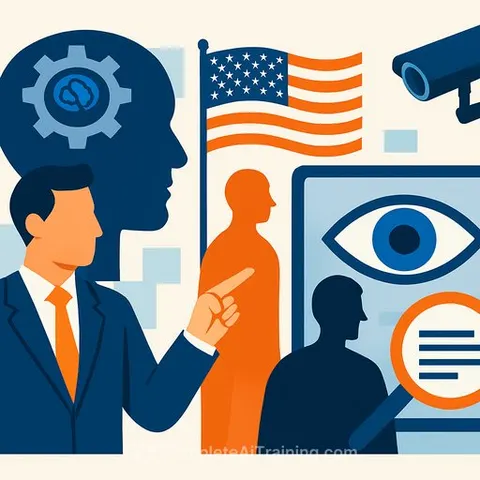
AI-Powered Surveillance Pushes Congress to Reconsider Warrantless Monitoring Law
Lawmakers are racing to reform a Cold War-era surveillance law before artificial intelligence makes government monitoring of Americans vastly more efficient. The debate centers on Section 702 of the Foreign Intelligence Surveillance Act, which expires Monday but has been granted a 10-day extension while Congress negotiates new safeguards.
Section 702 allows the government to collect communications from foreigners abroad. The problem: it also sweeps up messages and emails from Americans who contact those foreigners-and the government can search that American data without a warrant. AI systems can now process these databases far faster than humans ever could.
"Imagine instead of doing a query with one person that you turned AI loose on these databases," said Rep. Thomas Massie, R-Ky. "There's virtually nothing the government can't know about you."
A bipartisan coalition emerges
A group of Republicans and Democrats has introduced the Government Surveillance Reform Act, citing years of documented abuses. Sen. Ron Wyden, D-Ore., pointed to cases where officials searched Section 702 data to find Black Lives Matter protesters, political donors, elected officials, and a state judge.
The intelligence community argues that warrants would cripple national security operations. The CIA says Section 702 helped prevent a terror attack at a Taylor Swift concert in Austria. But civil liberties advocates counter that Americans' data gets collected incidentally, then searched without their knowledge or consent.
"The FBI can search for a person, for an American, without a warrant," said Jason Pye, vice president of the Due Process Institute. "That's what we're trying to solve."
The data broker problem
Congress is also debating restrictions on government purchases of commercial data. Private brokers collect and sell Americans' location data, browsing history, travel patterns, and purchase records to anyone willing to pay-including federal agencies.
The NSA and FBI have acknowledged buying this data. Combined with AI's ability to find patterns across massive datasets, government agencies could track Americans with unprecedented precision without ever obtaining a warrant.
"You can just have AI finding the patterns, aggregating data and allowing the government to build this enormous surveillance state," said Brendan Steinhauser, CEO of the Alliance for Secure AI.
Tech companies take different stances
In March, Wyden sent letters to major AI companies asking whether they would allow the government to use their tools for surveillance. Only Anthropic and Google responded.
Google's response acknowledged the concerns but provided few details about how government users analyze foreign intelligence data. Anthropic took a clearer position: it banned analysis of bulk domestic data collection but granted an exception for a small number of national-security customers analyzing foreign intelligence-even if that data includes Americans' information.
Anthropic's CEO Dario Amodei stated in February that the company supports lawful foreign intelligence work but opposes "mass domestic surveillance" as incompatible with democratic values.
The political pressure intensifies
House Speaker Mike Johnson introduced a three-year extension Thursday that adds some safeguards but not the warrant requirement that reform advocates sought. Last week, 20 House Republicans staged a midnight revolt, blocking both a five-year extension and an 18-month reauthorization.
Even some Democrats who voted for Section 702 in 2024 now refuse to reauthorize it without meaningful changes. Rep. Jamie Raskin, D-Md., noted that oversight mechanisms have been gutted and that "the watchdogs are gone."
The stakes are clear: without reform, AI will make it easier for government agencies to search Americans' communications and movements without judicial approval. With reform, officials argue, national security operations could suffer. Congress has 10 days to decide which risk it's willing to accept.
For government workers, understanding these changes matters. Your agency may be among those purchasing commercial data or searching Section 702 databases. The rules governing how that data can be used are about to change-or stay the same. Learn more about AI for Government and AI for Legal to understand how these tools are being deployed in federal operations.