
AI news ·
Lawyers and lawmakers wrestle with how to classify AI as legal frameworks struggle to keep pace
Courts and lawmakers are struggling to assign legal responsibility for AI-caused harm, starting with a basic dispute: is AI a product, a service, or something else? The answer determines who pays damages.
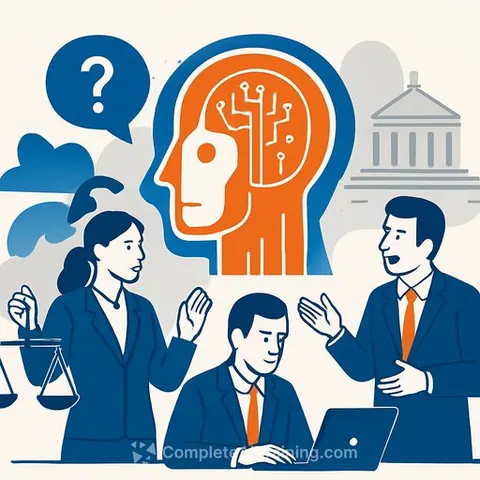
Who Bears Responsibility When AI Systems Cause Harm?
Lawyers worldwide are grappling with a fundamental question: Can artificial intelligence tools be held legally responsible for harm? As AI systems grow more powerful and autonomous, courts and lawmakers are racing to develop frameworks that assign liability and accountability before capabilities outpace existing law.
The question cuts deeper than criminal responsibility. It hinges on how the law classifies AI in the first place.
The Classification Problem
Depending on context, AI tools could be treated as products, services, autonomous agents with reasoning capacity, or - in speculative legal corners - entities deserving some form of legal personhood. Each classification carries different liability implications.
If an AI system is classified as a product, liability follows standard product liability law. If classified as a service, it falls under civil rights laws, fairness statutes, and accountability standards that apply to human services. The distinction matters enormously when determining who pays damages.
Patricia Williams, a law professor at Northeastern University, frames the core issue plainly: "The fundamental question is: What is a chatbot?"
Currently, most agentic AI systems - those with capacity for independent action - are treated in legal circles as inanimate objects lacking consciousness or self-awareness. But that classification may not hold as systems become more sophisticated.
The U.S. Approach: Preemption and Specificity
American lawmakers are moving in different directions. Ohio, Idaho, and Utah have introduced measures explicitly declaring AI systems "nonsentient" and opposing legal personhood classifications. This preemptive approach aims to foreclose future arguments that AI deserves rights or protections reserved for persons.
California and Colorado have taken a narrower path, focusing on regulating how AI is deployed in employment, housing, health care, and discrimination cases rather than debating ontological status.
Europe's Broader Framework
European regulators have adopted a more expansive approach. The General Data Protection Regulation, enacted in 2018, treats large online platforms and data intermediaries not merely as information hosts but as entities with affirmative legal responsibilities for data collection, storage, and processing.
This reduces what legal scholars call the "accountability gap" - the space between AI system behavior and human creator responsibility. Under GDPR, platforms cannot easily disclaim responsibility for algorithmic harms.
The difference stems from constitutional structure. The European Union explicitly enshrines privacy rights in its constitutional framework, allowing regulators to implement protections statutorily. The U.S. lacks comparable constitutional privacy language, relying instead on fragmented court decisions interpreting the Fourth, Fifth, and 14th Amendments.
Ownership and Authorship in Flux
As AI systems generate content - songs, novels, patents - another legal problem emerges. Most existing patent and copyright law requires that inventors and authors be human beings.
Under current frameworks in the U.S., U.K., and Europe, AI-generated works cannot hold their own copyrights. Patent law stipulates that "the inventor must be a human" - in other words, sentient. This creates a gap: Who owns what AI creates, and who bears liability if that creation infringes existing rights?
Courts have not yet settled these questions. As AI capabilities expand, legal definitions will determine whether companies, users, or AI systems themselves bear responsibility for harm, discrimination, or rights violations.
Learn more about AI for Legal professionals or explore the AI Learning Path for Paralegals to understand how these emerging frameworks affect legal practice.