
AI news ·
Leaders at India AI summit warn traditional degrees and narrow skills are losing relevance
AI automation outpaces India's education and workforce systems, summit leaders warned. MIT is launching a platform aiming to reach one billion learners.
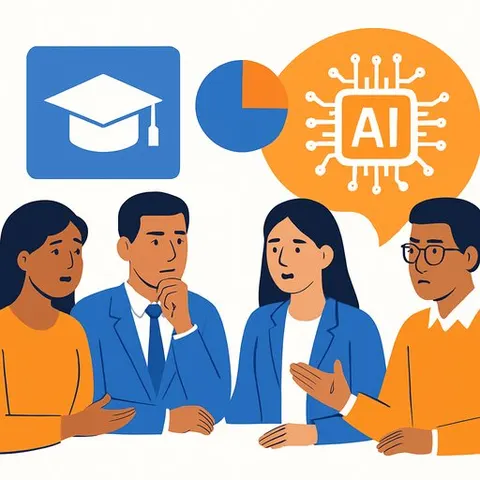
Artificial intelligence is moving faster than India's education and workforce systems can absorb, leaders at the India AI Impact Summit 2026 warned, as narrow technical training and traditional degrees lose relevance in the face of automation. Across four sessions on skilling, higher education, employability, and leadership, speakers agreed that while degrees may fade in importance, human capability will not.
Degrees to 'quality at scale'
M.S. Vijay Kumar, a professor affiliated with the Massachusetts Institute of Technology, reframed the conversation by placing AI within a longer arc of educational change. "As futurists, we do not predict the future, we help make preferred futures possible," he said. The real challenge, he argued, is understanding what must remain invariant amid rapid innovation.
Kumar pointed to MIT's 1999 decision to launch MIT OpenCourseWare, a bold experiment that made course materials freely available worldwide. At the time, MIT confronted a core dilemma: What is the true value of an MIT education? The answer lay not in content alone, but in active learning, "minds-on, hands-on" engagement, and analytical rigor blended with real-world problem solving. "Education is both a contact sport and a team sport," he said.
Today, scale means something far more complex. Learners are no longer just 17-year-olds entering university; they are mid-career professionals, entrepreneurs, and workers navigating reinvention. MIT has launched a modular, AI-enabled learning platform designed to provide foundational AI courses followed by domain-specific applications, with an ambition to reach a billion learners. The new model of scale, Kumar said, rests on three pillars: learning science, AI-enabled personalization, and ecosystems and partnerships across academia and industry.
Decoding the hardest skill
Sanjay Jain of Google offered a grounded reflection on the human side of adaptation. "It's not that people don't want to learn new things," he said. "But change doesn't come naturally to us." A 25-year-old may experiment freely with AI tools; a 50-year-old professor who has built decades of expertise may hesitate, understandably.
Yet Jain cited an inspiring counterexample: a professor at IIT Tirupati who uses NotebookLM to teach research skills from the very first class. For educators, building that comfort with AI tools requires structured learning. An AI Learning Path for Teachers can provide the foundation. Jain distilled adaptation into two requirements: the willingness to learn, and the discipline to do the harder work of answering the complex questions students now ask. Those questions, he emphasized, are only getting tougher.
The employability shift
Vineet Nayar of Sampark Foundation reframed AI through economic history. The Industrial Age, he argued, created value not just through machines but through a management idea: break complex processes into smaller sub-processes. This "de-skilling" enabled mass employment, and education systems adapted to produce knowledge workers trained in narrow, task-specific sub-skills. That model powered India's IT boom.
Now AI is automating those very sub-skills. "The crisis emerges there," Nayar said. In the AI age, macroskills - creativity, problem-solving, and reimagination - become the new currency. "AI is not merely technology," he said. "It becomes powerful only when applied to meaningful use cases." Teaching children AI tools as a technical subject is insufficient; what they must learn is imagination. Nayar also issued a strategic warning about data sovereignty: as global large language models expand, Indian data becomes fuel for foreign systems. Without domestic AI capability, India risks repeating the pattern of the early software era, celebrating short-term benefits while losing long-term competitive advantage.
Smita Prakash of ANI brought the debate into the newsroom, calling AI a stress test for journalism. Students are already using AI tools, sometimes quietly, even as parts of the education system resist recognizing AI as foundational literacy. She argued that AI learning should begin as early as middle school - a perspective that echoes the growing push for AI for Education initiatives that equip both students and teachers with foundational literacy. Prakash also described a growing problem: identical AI-generated resumes flooding inboxes, where candidates polish profiles using tools but lack the underlying skill when interviewed. Budget constraints, she warned, are pushing news organizations to rely heavily on AI-generated content rather than on-ground reporting. "This is not just disruption," she said. "It is an existential challenge."
Building AI champions
Aparna Ganesh of Tata Sons shifted the lens to enterprise leadership. "How do we design specialized programs for senior leadership so they truly understand the art of the possible?" she asked. Leaders must anticipate disruption, not merely respond to it. Within Tata, the focus is on building AI champions - business managers who constantly reimagine operations, value creation, and outcomes. But the pace of AI evolution creates a persistent challenge: by the time one round of upskilling is complete, the landscape has already shifted.
Why this matters for education professionals
The summit's core message for educators is that tool literacy alone will not sustain careers - or students. What will matter are macroskills: imagination, adaptability, judgment, and the ability to collaborate with machines without surrendering human agency. For teachers and administrators, the immediate step is to treat AI not as a threat but as a lever that can reduce time spent on mundane tasks and free up capacity for deeper student engagement. The alignment of education, enterprise, and policy is critical; without it, AI risks widening gaps rather than expanding opportunity.