
AI news ·
Leadership Circle resolves 71% of support requests with AI, cuts manual tickets by 65%
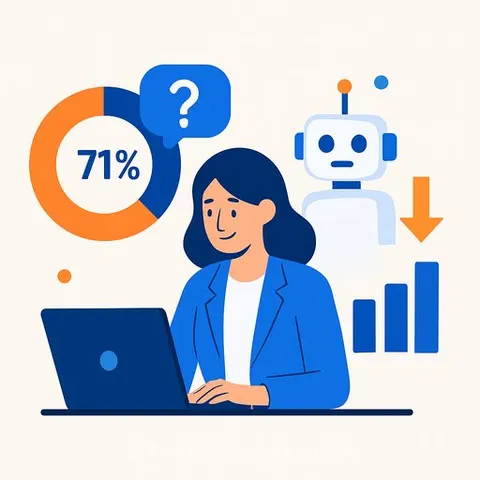
Leadership Circle cut manually handled support tickets by 65% and hit a 71% AI resolution rate across 3 million customers in 21 languages. The firm's five-step approach shows how support teams can shift from ticket-closing to revenue-driving work.
From Cost Center to Growth Engine: How Leadership Circle Built AI Support That Actually Solves Problems
Leadership Circle, a global leadership development firm serving 3 million customers across 21 languages, faced a familiar problem: support was scattered across disconnected systems, buried help content wasn't being found, and the team spent most of its time closing tickets instead of building customer relationships.
The company implemented an AI-first support platform and achieved a 71% resolution rate through AI, reduced manually handled tickets by 65%, and turned support into a revenue driver. The transformation offers five concrete lessons for support teams considering similar moves.
1. Measure whether customers got help, not whether AI handled the ticket
The support industry has fixated on AI containment rates-the percentage of interactions handled without human involvement. This metric tells you nothing about whether customers actually solved their problems.
Leadership Circle focused instead on AI resolution rate: did the customer get what they needed? A G2 study found that 7 out of 10 customers have stopped doing business with a brand due to poor service. Containment metrics miss that entirely.
By tracking whether customers were actually helped, not just whether interactions were deflected, Leadership Circle resolved 71% of incoming requests on the first pass. The difference matters for retention, word-of-mouth, and competitive advantage.
2. Redeploy your team to work only humans can do
Most AI support stories end with efficiency gains. Leadership Circle asked what came next: what should our people do now?
With routine volume handled by AI, the customer success team shifted entirely. Instead of processing tickets, they built high-value coaching relationships, identified upsell opportunities that drove revenue directly, and had proactive conversations that deepened partnerships.
Amy Felix-Reese, Managing Director for North America, said the shift was essential: "By automating the routine, we're freeing our people to focus on relationships, upsell opportunities, and the interactions that actually drive revenue."
This isn't replacement. It's redeployment. When routine requests don't consume your team's time, they can do work that builds loyalty and grows accounts.
3. Support 24/7 across languages and channels without scaling headcount
Leadership Circle now handles 3 million customers across 21 languages from a single platform. The AI agent responds in the customer's language, around the clock, across web, email, and chat-with no handoff friction when human judgment is needed.
Miranda Dunn, Director of Global Transformation and Change, discovered the platform's analytical capability while investigating a recurring problem. About 700 support tickets per month involved login issues.
She asked the AI to assess whether their existing help article solved those tickets. The AI reported it would fix only 25% of them. She then asked it to generate a comprehensive article based on every agent response since launch. The result: an estimated 1,200 team hours saved annually.
"I didn't need to be an IT expert," Dunn said. "Having it all in one spot, I could find insights myself, look at trends, and escalate issues without needing others to do it for me."
4. AI requires continuous coaching, not set-and-forget deployment
The best AI systems aren't the ones with the fanciest models. They're the ones with the tightest feedback loops.
Leadership Circle reviews every AI conversation to understand where the agent falls short. They coach the AI directly by providing guidance on better responses for specific scenarios. They test new versions against real tickets to measure whether each iteration improves resolution quality.
When a human resolves something the AI couldn't, that resolution becomes training data. The AI gets smarter. The knowledge base gets richer. The next customer with the same question gets the right answer.
This habit-reviewing, coaching, and versioning from day one-compounds over time and separates successful deployments from failed ones.
5. Connect support to product, engineering, and the rest of the business
Support has historically operated in isolation. Leadership Circle changed that by moving to a unified platform where support, engineering, and product share the same customer context.
Support agents now see full customer history, entitlements, and open requests across every channel. When a fix requires development help, issues go directly to Jira. Product teams see customer pain points reflected in support interactions, which shapes roadmaps and surfaces high-value requests.
Dunn can now connect confidently with product and engineering teams during launches, ensure customer success materials are ready from day one, and spot trends across the business without waiting on other departments.
"Everything lives in one place," she said. "I can do more of that lifting myself rather than waiting on others, making cross-team conversations less about dependency and more about collaboration."
The results speak to the approach
Leadership Circle started with a clear philosophy: AI plus people, not AI versus humans. They measured customer outcomes, not cost efficiency. They spent time deeply integrating and managing AI rather than deploying it and moving on. They connected support to the rest of the business.
The outcomes: 71% AI resolution rate, 65% fewer manual tickets, and a support function that now drives revenue. The team went from fearing job loss to discovering what's possible when routine work is handled by machines and people focus on what builds business.
Dunn summarized the balance: "It's not about a bot answering the questions. It's about leading people on a journey and helping them come to a solution. It's a beautiful balance of AI and people."
For support leaders evaluating AI for Customer Support and AI Agents & Automation, the message is straightforward: success comes from AI and humans working together, not from choosing one over the other.