
AI news ·
Lenovo brings manufacturing AI from pilot to production at Hannover Messe as industry investment surges
94% of manufacturers plan to raise AI spending in 2026, moving from pilots to full deployment. Lenovo reports its AI systems cut lead times 85% and logistics costs 42% at its largest North American plant.
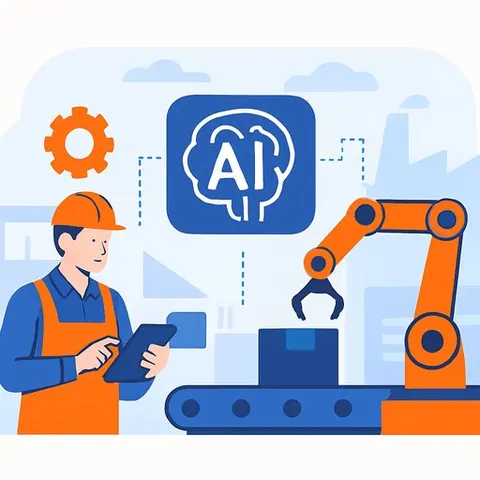
Manufacturers Rush to Move AI From Pilot Projects to Production
Ninety-four percent of manufacturers plan to increase AI investment in 2026, signaling a shift from experimentation to deployment at scale. The move comes as companies face supply chain volatility and rising operational complexity, with AI now treated as an operational requirement rather than a future consideration.
Lenovo and NVIDIA are demonstrating production-ready AI systems at Hannover Messe 2026 that deliver measurable results. At Lenovo's largest North American manufacturing site, AI deployment reduced lead time by 85%, cut logistics costs by 42%, and boosted productivity by 58%.
Jonathan Wu, Chief Technology Officer of Smart Manufacturing at Lenovo, said the industry has moved past the pilot phase. "Manufacturers don't need more AI pilots. They need AI that runs at scale in production," he said.
Quality Inspection Across Connected Production Lines
Real-time quality control now extends beyond isolated inspection points. Lenovo applies computer vision, edge AI, and digital twins across production environments to detect defects as they occur and perform faster root cause analysis.
This approach connects quality insights with material flow, equipment performance, and upstream inputs. Defects are identified before they impact downstream operations. Lenovo has deployed its Automatic Quality Inspection Robotic Cell at facilities in Brazil, Hungary, and Mexico with measurable improvements in consistency and efficiency.
Material Movement Automation
Production performance depends on how effectively materials move across the factory floor. Lenovo's Multi Purpose Robots enable real-time automation for line-side delivery, picking, kitting, and material movement between production stages.
By reducing manual processes and improving material flow, manufacturers maintain more stable production, increase overall equipment effectiveness, and respond more quickly to demand changes.
Supply Chain Visibility and Operations Monitoring
Lenovo iChain connects suppliers, logistics partners, and manufacturing operations through real-time data sharing. This improves coordination between material supply and production scheduling and increases visibility across multi-tier supply chains.
Electronics manufacturer Hisense implemented AI-driven operations monitoring across its environments and achieved 100% monitoring coverage, a 40% reduction in alert volumes, and 50% faster issue investigation. Lenovo ranked eighth in the Gartner Supply Chain Top 25 for 2025.
Moving Pilots to Production
Most AI initiatives in manufacturing stall before reaching production because tools are not designed for live, complex environments. Lenovo closes this gap by offering solutions already running at scale across its global operations.
Lenovo's Hybrid AI Advantage integrates infrastructure, data, models, and services across edge, cloud, and on-premise environments. The approach is built for real-world conditions rather than controlled settings.
Lenovo ThinkStation PGX powered by the NVIDIA GB10 Grace Blackwell Superchip provides sandbox and simulation capabilities to train and validate robotic systems before deployment. Lenovo ThinkEdge processes data and runs AI models at the point of action for visual inspection, predictive maintenance, and autonomous systems.
Operations professionals implementing AI should understand that AI for Operations covers supply chain optimization, logistics automation, and process improvement. For operations managers leading these initiatives, an AI Learning Path for Operations Managers addresses process optimization, supply chain management, and workflow automation.
Lenovo is showcasing its manufacturing solutions at Hannover Messe Hall 15, Stand G76.