AI in 2026: How Management Roles and Organisational Design Will Change
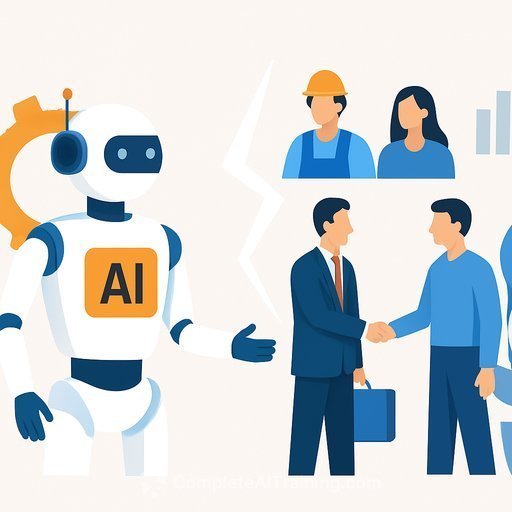
AI is about to pull managers out of inboxes and into higher-impact work. Admin heavy tasks will shrink. The job shifts to orchestration, judgment, and leading teams through change. Here's what's coming and how to get ahead of it.
From Supervisor to Orchestrator
By 2026, the bulk of routine management tasks will be automated. Your value moves to setting direction, coaching people, and deciding when to trust or challenge AI recommendations.
- What AI absorbs: scheduling, basic approvals, reporting, data aggregation, status updates, first-draft analysis.
- What stays with you: prioritisation, exception handling, trade-offs, conflict resolution, stakeholder alignment, and ethical calls.
Managers become translators between business context and AI output. You'll need solid AI literacy, but people skills and clear thinking will carry the day. A practical starting point is the AI Learning Path for Business Unit Managers.
Org Design: Flatter, Networked, AI-Enabled
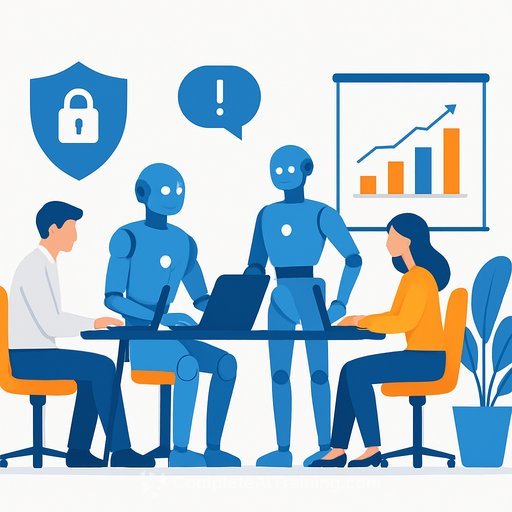
Expect less hierarchy and more cross-functional squads. AI reduces the need for layers that only pass information up and down.
- AI governance hub: ethics board, model ops, data stewardship, risk oversight.
- Enablement pods: product- or domain-level teams that embed AI into workflows and train staff.
- Hybrid teams: human specialists working with AI copilots; roles include AI interaction and prompt expertise.
- Outcome focus: KPIs shift from activity to results, supported by real-time analytics.
Decision-Making and Accountability
Decision loops become human+AI. Systems propose options, surface risks, and estimate impact. You supply context, values, and the final call.
- Set thresholds: define which decisions AI can auto-approve and where human review is mandatory.
- Document rationale: require brief, plain-English justifications from humans and machine explanations from models.
- Clarify liability: align with legal and risk teams; managers act as auditors of AI behaviour.
If you need a starting point for risk controls, review the NIST AI Risk Management Framework and the evolving EU AI Act guidance.
Workforce and HR Implications
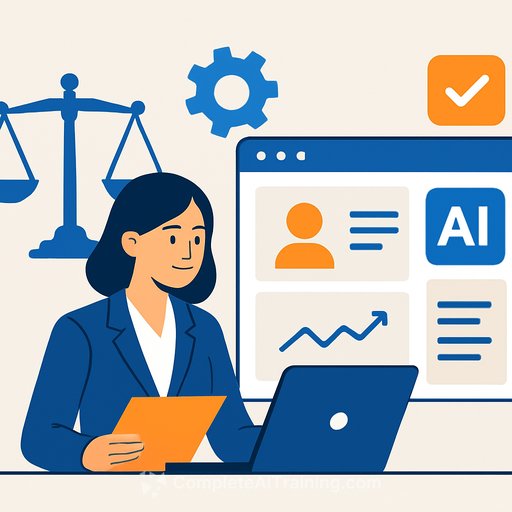
Roles will be redesigned. HR will use AI for talent matching, internal mobility, and personalised learning. That can help, but watch for bias and data quality issues.
- Build reskilling plans for managers and frontline staff, with hands-on practice.
- Update job descriptions to include AI interaction, review, and escalation skills.
- Provide clear career paths for hybrid roles (analyst+AI, PM+AI, ops+AI).
Risks to Watch-And What to Do
- Opaque models: require explainability and model cards; implement independent reviews.
- Bias amplification: set fairness metrics; monitor drift; audit sensitive outcomes.
- Over-reliance: set quality checks and exception sampling; train for healthy skepticism.
- Job displacement: pair automation with reskilling and internal placement commitments.
- Centralised power: avoid bottlenecks by pairing central governance with local enablement.
Your 12-Month Action Plan
- Q1 - Assess and Pilot
- Map repetitive manager tasks; pick 2-3 pilots with clear ROI and low risk.
- Define human-in-the-loop checkpoints and escalation rules.
- Q2 - Build the Guardrails
- Stand up AI governance (policy, risk, model ops, data stewardship).
- Create lightweight documentation: data lineage, model purpose, evaluation results.
- Q3 - Redesign Work
- Rewrite roles and workflows for human+AI collaboration.
- Run manager training on AI literacy, decision quality, and coaching.
- Q4 - Scale and Measure
- Expand successful pilots; sunset legacy reports and approvals that AI replaces.
- Publish a quarterly scorecard and a short "what we learned" note.
KPIs That Matter
- Cycle time for key decisions
- Exception rate and rework
- Quality deltas (accuracy, defects, customer impact)
- Manager time reallocated to coaching and strategy
- Model audit pass rate and explainability coverage
- Employee engagement and skill progression
Sector Nuances
- Financial services: strict controls, strong model risk management, detailed audit trails.
- Healthcare: clinical safety and consent first; human review on all patient-facing decisions.
- Manufacturing: predictive maintenance and quality control; tight integration with MES/SCADA.
- Public sector: transparency, service equity, and documented human oversight.
Practical Guardrails You Can Copy
- Define a "no-go" list (use cases you won't automate yet) and a "safe-to-try" list.
- Set review cadences: weekly pilot standups, monthly risk reviews, quarterly audits.
- Use red-teaming and scenario tests before scale-up.
- Maintain an incident log for AI-related issues with clear fix owners.
Tools and Upskilling
Pick tools that integrate with your data, provide solid access controls, and offer clear monitoring. Your managers need reps with real tasks, not just theory.
- Explore role-based learning paths: AI Learning Path for Project Managers.
- Build credibility with structured learning: AI Learning Path for Training & Development Managers.
Bottom Line
AI will take the busywork and surface better options. Your edge is clear judgment, focused teams, and tight guardrails. Start small, measure hard, and teach your managers to lead with AI-without handing over the keys.
Your membership also unlocks: