AI That Solves Mission Problems in Real Time: What Managers Need to Know
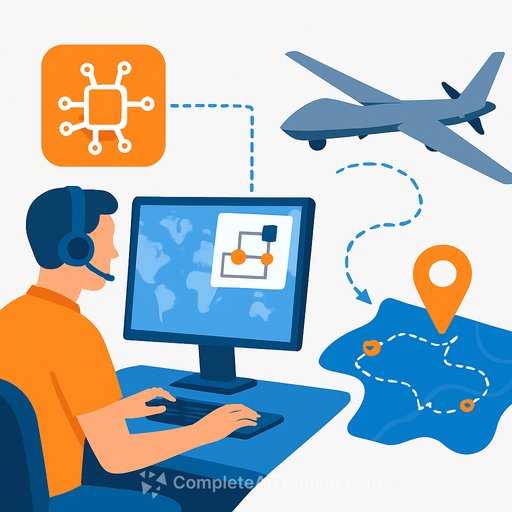
Lockheed Martin Skunk Works® ran a live demo of AI-driven mission-contingency management on a Stalker XE Block 25 UAV and a modified Alta X 2.0 drone. The system detected a fuel issue, generated re-plan options in seconds, and let the operator approve the best one. Once selected, the AI re-tasked the Alta X to finish the job and sent the Stalker back to base. Human judgment stayed in the loop; the AI handled the heavy lift.
Why this matters for leadership
- Operational resilience: missions keep moving even when assets fail or conditions change.
- Speed: decision latency drops from minutes to seconds, especially during off-nominal events.
- Workforce leverage: operators supervise and approve, while AI handles re-planning and task hand-offs.
- Interoperability: one node coordinated air and ground assets, signaling lower integration overhead.
- Risk control: clear approval points preserve accountability and reduce error cascades.
How the demo worked
The exercise simulated multiple fuel contingencies on the Stalker XE. The ground C2 AI assessed the situation, produced re-plan options, and surfaced them to the operator via a simple interface. After the operator chose a path, the AI shifted tasks to the Alta X and commanded the Stalker to return to base. The outcome: faster recovery with the operator focused on mission priorities rather than manual re-tasking.
One command node, air and ground
The Stalker fed mission data to a unified C2 node that also managed an Unmanned Ground Vehicle in Kansas, with support from Fulcrum-provided UAVs. This showed cross-domain control from a single, mobile command node. It directed multiple, geographically separated drone meshes in mounted, dismounted, and below-the-noise setups, which points to scalable control across dispersed operations.
The tech behind the hand-off
The team used STAR.SDK™ within the STAR.OS™ constellation to plug the contingency app into a chat-based interface for operator approval and re-tasking. That same foundation enabled different AI systems to interoperate across unmanned platforms without bespoke wiring each time. More on multi-domain integration is available at Lockheed Martin's site: Multi-Domain Operations.
Leadership playbook: first 90 days
- Run a tabletop on your top five contingencies (fuel, comms loss, sensor failure, weather, geo-fence breaches) and define who approves which automated actions.
- Set human-on-the-loop thresholds: which events can auto-execute with notification, which require a quick confirm, which mandate a hold.
- Pilot within a low-risk mission segment; collect data on re-plan speed, mission continuity, and operator workload.
- Demand open interfaces for C2 and telemetry so you can mix vendors without lock-in.
- Update SOPs: escalation paths, fallback modes, and training for supervisors to audit AI decisions.
Risks and guardrails
- Model reliability: validate on real-world edge cases, not just clean lab scenarios.
- Comms denial: ensure degraded-mode behaviors and delayed-sync logs for after-action review.
- Cybersecurity: treat the C2 node as a tier-one asset; require secure boot, signed updates, and continuous monitoring.
- Authority and ethics: retain human approval for target changes and mission aborts; align with published principles such as DoD AI ethical principles.
Metrics that matter in pilots
- Time from contingency detection to approved re-plan.
- Mission completion rate after a contingency event.
- Operator interventions per flight hour and per asset.
- Operator workload (e.g., NASA-TLX or equivalent) before vs. after AI/MCM.
- Comms bandwidth used during re-plan and task hand-off.
Procurement checklist
- Evidence of cross-vendor UxV control from a single C2 node.
- APIs, data schemas, and SDK support (documentation, SLAs, version cadence).
- Built-in audit logs: what the AI proposed, what the operator approved, and timing.
- Simulation hooks for scenario stress-tests and red-team exercises.
- Fallback behaviors: hold, return-to-base, safe loiter, and human override.
What the team said
"This demonstration proves AI can move from the lab to the battlefield, delivering a multitude of capabilities ranging from autonomous decision-making to rapid data flow between unmanned vehicles across air, ground and synthetic environments," said OJ Sanchez, vice president and general manager, Lockheed Martin Skunk Works. "By fusing AI-enabled UAV replanning with UGV capabilities, we give warfighters the safety, speed and confidence they need to act first in contested environments."
Take the next step
If you're standing up internal capability, review curated training by role: AI courses by job. Equip supervisors and mission owners to read, challenge, and approve AI-generated plans with confidence.
Your membership also unlocks: