
AI news ·
Majority of Georgia teachers use AI for teaching tasks, state audit finds
A survey of 13,000+ educators found 59% use generative AI for lesson planning. Yet 62% never use it to grade student work.
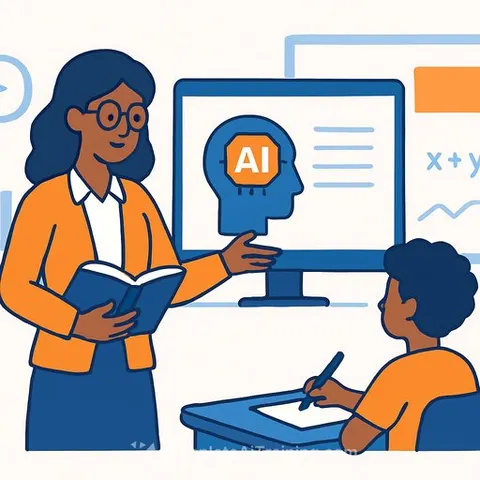
A new state audit reveals that 59% of Georgia teachers now use generative AI for classroom tasks, with instructional planning and preparation as the dominant use case. The findings come from a survey of more than 13,000 educators across the state, signaling a rapid shift in how teachers approach lesson design even as many worry about the technology's effect on student learning.
Teachers lean on AI for planning, but steer clear of grading
Among teachers who use AI, 95% said they turn to the technology for instructional planning at least a few times a year, and more than half do so at least once a week. The technology has become a routine time-saver, with nearly 90% of AI-using teachers reporting a positive impact on their classrooms. They said it helped them save time, improve lesson materials, and boost student engagement. But grading remains a hard line: 62% of respondents said they never use AI to assess student work.
Venecia Whyte-Foster, a middle school English teacher in Savannah-Chatham County, described building personalized chatbots that transform classroom concepts into escape-room-style games. "They have to ask a question directly toward the topic, and then the chatbot will give them more questions, give them information and then ask them questions, and until they're able to answer those questions effectively, they cannot move on," she said. "And they love those escape rooms, they love to be the first to get out of the room."
For educators looking to develop these skills systematically, an AI Learning Path for Teachers provides structured guidance on integrating AI into lesson design and classroom activities without sacrificing pedagogical control.
Student AI use alarms middle and high school teachers
Teachers report that student adoption of AI climbs with age. A majority of high school teachers said their students use AI on assignments at least half the time, and those educators were more likely to say the technology had a negative impact on learning. In middle and high school, a majority of teachers described AI's effect on student learning as either somewhat negative or very negative.
To manage this, more than half of surveyed teachers require in-class work or writing assignments. Half explicitly define AI abuse and cheating, and 43% use software to check for AI-generated content. Whyte-Foster said she teaches students about AI hallucinations-fabricated responses that sound confident-and stresses the importance of verifying information. When she catches AI-generated work, she talks with the student about academic integrity and offers a chance to redo the assignment for a reduced grade. "They'll tell you, yes, they'd prefer a 70 to a zero," she said.
Training and guidance remain uneven
About two-thirds of teachers said they received guidance on AI use, and 70% reported receiving training. But 27% had neither, and responses varied within districts, suggesting either inconsistent rollout or poor awareness of existing resources. Teachers in high-poverty districts were more likely to report a lack of guidance or training. The Georgia Department of Education appointed an AI ethics and impact officer in January 2025 and released best-practice guidance, with State School Superintendent Richard Woods emphasizing that "AI should always be a tool, never a replacement."
University of Georgia associate professor Xiaoming Zhai, who directs the AI4STEM Education Center, urged teachers to stay open to the technology. "Regardless of whether they're using AI in their own profession, their students in the future will be using AI in their career," he said. "So if they're not able to use AI, how can they expect them to educate the future workforce to be able to use AI responsibly and ethically?" Resources tagged under AI for Education can help teachers build that capacity while addressing ethical concerns head-on.
Why this matters for educators
The Georgia data shows that AI is already a fixture in lesson planning for a majority of teachers, but the gap between teacher adoption and student readiness is widening. Teachers who integrate AI into their own workflow gain firsthand experience with the tool's limitations-hallucinations, bias, shallow outputs-that they can then teach students to recognize. The most pragmatic step is to seek out training that covers both productive use and academic integrity guardrails, especially in schools where district guidance is thin. Without that fluency, teachers risk policing a tool they don't fully understand while students use it anyway.