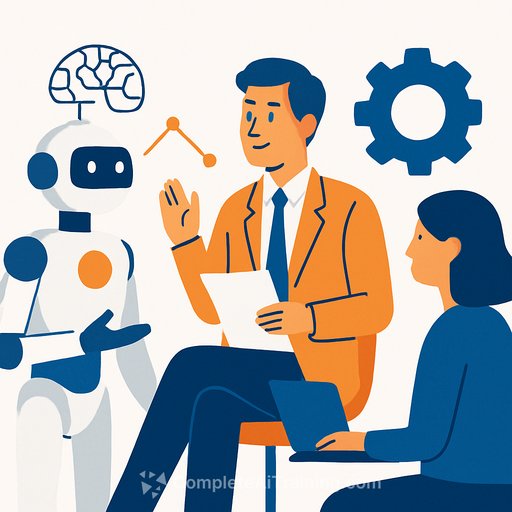
Leading in the Age of AI: Rethinking Management
For decades, management training focused on leading people—courses, certifications, coaching, culture decks—all aimed at improving human leadership. But the landscape is shifting. Many managers now find their direct reports are not people, but AI agents. For example, BNY Mellon recently onboarded 1,000 digital workers, and JPMorgan Chase is scaling AI teams. These new "employees" don’t need coffee breaks, feedback sessions, or time off.
The Problem? Legacy Management Models
Most organizations still use management frameworks designed for human teams. These models don’t fit well when your team includes machines.
Leading Humans Versus Governing Agents
Managing people means guiding behavior—motivating, delegating, coaching, and course correcting. It’s a cycle built on trust and conversations. Managing AI is different. You don’t coach a model; you govern it. That means defining clear inputs, monitoring outputs, escalating issues, and being accountable for the results.
Leadership in AI teams shifts from motivation to judgment. Success depends on assessing, adjusting, and acting quickly within decision chains. It’s about spotting when things go off track, asking the right questions before errors occur, and owning outcomes—even those you didn’t create directly.
The HR Model is Out of Sync
HR frameworks still assume linear career paths, human reports, and long-term roles. Digital agents don’t follow these rules. They don’t climb ladders; they execute tasks. One day they outperform junior staff, the next they’re outpaced by newer models. You don’t manage their growth, but the environment they operate in.
This shift challenges traditional organizational design. Hierarchies built for human oversight struggle when AI systems act faster than approval processes. This calls for new definitions of productivity, collaboration, and leadership.
New management metrics should focus on how humans and AI interact. Are employees writing effective prompts? Are they escalating ethical concerns? Are they critically reviewing AI outputs or blindly approving them? These become key leadership signals, yet most performance reviews miss them.
Prompting is a Leadership Act
Prompting isn’t just technical skill—it’s a core management skill. The way you frame a prompt determines AI behavior. Vague prompts yield vague results. Biased prompts produce biased outcomes. Poor prompting isn’t only inefficient; it can cause legal or reputational damage.
Many companies treat prompting as an engineer’s job or something for AI power users. That’s a mistake. Everyone managing AI agents—from interns to executives—needs to craft clear, intentional instructions. Prompts are decisions embedded in organizational context, shaped by purpose and place.
The Ethics Chain is Breaking
In traditional teams, ethical issues follow a clear chain of command: problems get flagged, and managers intervene. With AI agents acting independently and often invisibly, that chain breaks down. Problems go unnoticed without clear escalation paths.
Companies often haven’t defined ethical escalation when the actor is synthetic. Who’s responsible when AI produces biased recommendations, leaks sensitive data, or makes questionable decisions? If your answer is “the tech team,” you’re not prepared.
Governance must be embedded in team workflows, not left to back-office functions. Leading companies train their teams to pause, question, and report AI outputs rather than accepting them blindly. Techniques like "chain of thought" reasoning help spot bias and errors early. This skill will become increasingly important.
The Bottom Line
AI won’t replace all managers, but it will redefine management. Leading AI agents requires new skills most organizations haven’t developed. It’s about shifting from passive management to active stewardship: less pleasing, more accountability; fewer status meetings, more clear escalation paths.
Managing AI still means leading people. But the people you lead need new tools, rules, and playbooks. Success won’t come from flashy tech alone, but from mastering how to manage what you build.
For managers looking to build these essential skills, exploring AI training courses designed for management roles can provide practical guidance on prompt design, AI governance, and ethical oversight.
Your membership also unlocks: